
TL;DR
- Your memory is not a marketing plan. A prospect can’t see deals you remember but never wrote down.
- One deal is a story. Ten connected deals are a track record. Link them so they explain each other.
- A closing photo proves you showed up. It doesn’t prove what you did. Write that part down.
- Old deals still count. Just keep the date on them so nobody mistakes them for today’s market.
- The record only pays if you use it. Send it in follow-ups. Hand it to referral sources.
The right example turns up after the owner leaves
You are halfway home from a meeting in suburban Dallas when you remember the assignment you should have mentioned. Same kind of access problem. Same hesitation about timing. A different property, but useful experience.
At the office, you find a photograph. Then an old email. The explanation exists somewhere between your memory and a folder nobody else can read.
The owner has your name now. What can they find while you reconstruct the story?
A track record that lives only in your head makes you start over with every stranger.
Most advisors treat the closing as the end of the work. I think that’s the most expensive habit in our business. The deal ends. The proof shouldn’t.
I run marketing at Blue Collar Commercial Group. Our team’s experience got a lot more valuable the day a prospect could see it without one of us sitting next to them explaining it.
Interest is a comparison. Reuse is the actual mechanism.
No, a web page doesn’t earn interest like a bank account. But it does something close: every new deal makes the old ones more convincing.
Say you helped a tenant find industrial space outside Nashville. Write an accurate account of the operational questions, your role and the decision. Later, you help a warehouse owner think through tenant fit across town. That account adds the landlord’s side.
Put the pages together. A reader can now see how your understanding of occupiers connects to your work with owners. Each account gives the other context.
A pile of closing photographs does not make that connection for you.
The record compounds through connections and reuse. You can send the industrial account after a tenant conversation. You can send the landlord account when an owner asks about preparation. A colleague can pass either one along without first learning your entire career.
That’s the whole idea. The deal keeps working for you after it closes.
Stop treating the archive like a trophy shelf
A trophy shelf says you were there. A useful record says what you did.
Keep a track record: a dated account of completed work and your role in it. Add the question the client faced, the information that changed the approach and the result you can verify.
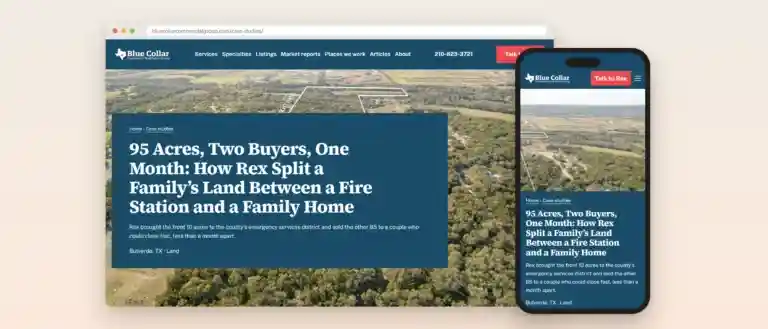
Say you advised on a land site outside Charlotte where access needed checking. The reader does not need a victory pose in front of the sign. They need to understand why access mattered and what was confirmed before the client moved forward.
Include tenant work. Include acquisitions. Include a referral when making the right introduction was your actual role. Your history should explain the practice you have, not just the assignments that produced good photographs.
Then connect related accounts. A reader interested in owner preparation should find other preparation work. A business looking for space should find tenant examples.
That takes editorial judgment. More pages alone are not the point. A warehouse full of unmarked boxes is technically an archive. Nobody wants to shop there.
The account needs an address you can keep
Use a website address you control as the home for the record. An owned domain is a web address registered under your control.
A social post can point to that page. A firm announcement can link to it. Your email can share it in a follow-up. Those are routes to the account, rather than substitutes for it.
Make sure you can save and move the writing and images. A website is only a durable home if you understand who controls it, who maintains it and what happens if you change services.
Keep your private files separately. The public account is a selected explanation, not the entire transaction file.
File by the client’s question
Make the collection useful without requiring the reader to know your career.
A prospect may want to see work in their town. They may want to see how you help owners prepare for a sale. They may want evidence of tenant work or help evaluating an acquisition.
Give them clear ways to find relevant accounts. That could mean simple page headings, links grouped by service or a short introduction pointing to examples.
A chronological list still has a place. Dates show when work happened. But chronology alone may not help someone find the situation closest to their own.
Keep the original date on old work
An old assignment can remain useful when the page is clear about when it happened.
Explain the decision and the conditions that mattered at the time. Do not describe those conditions as today’s market unless you have checked them again.
A case study is an account of a problem, the approach and the outcome. It can show judgment even when the market has changed. A current market note serves a different purpose.
Keep those jobs separate. A reader should be able to learn from the assignment without mistaking it for a current recommendation.
Make the role travel with the result
Describe your contribution precisely. A long record of transactions is less helpful when the reader cannot tell what you did.
Were you representing the owner, helping an occupier evaluate options or making an introduction? Did you coordinate information, market the property or help compare proposals?
State the role in plain words. Give other participants appropriate credit. Do not let the firm’s involvement stand in for your own account.
If you changed firms, preserve the context of earlier work where you are permitted to describe it. Avoid presenting a past firm’s assignment as work performed by your current firm.
Use the record while doing the next assignment
A track record should be something you use, not a page you admire after updating it.
Before a meeting, find an account that helps explain a relevant issue. In a follow-up, send the page with a short explanation of why it applies. When a referral source needs background, give them something specific to share.
You can also use the record internally. Reviewing past accounts may help you notice questions worth asking again or an explanation you have refined over time.
One caution: a similar deal is not a promise. Say what’s alike and what’s different.
Build the record before the new search becomes crowded
People already need an account of your work when they check a referral. AI adds another reason to make that account public and readable.
Real estate has the lowest AI-Overview trigger rate of any tracked industry: 0.14% (Haute Residence x 5WPR, April 2026). An AI Overview is the written summary Google sometimes places in search results.
Translation: Google’s AI summaries barely show up for real estate searches yet. The window is still open.
A track record takes years to build. Start now and you’ll have years of proof on the record, whatever the answers look like later. Wait, and you’ll be trying to build in a month what took others years.
Put the material on an owned domain, a web address registered under your control. Keep private copies. Make the text easy to read. The archive can serve referrals now while giving AI something to find.
Watch for real signs it’s working: you found the right story fast, an owner asked a sharper question, a referral source had something specific to forward.
Build a small connected record this week
Begin with work that is already easy to verify. Build a small, usable collection before trying to recover every assignment you have ever handled.
- Choose related assignments. Look for work that shows different sides of your practice or different approaches to a recurring problem. You are building an account of how you work, not a display of trophies.
-
Confirm the public facts. Check dates, property descriptions, client roles and your contribution. Determine what you are allowed to share. Leave anything uncertain in your private notes until it is resolved.
-
Give each account its own page. Use a clear title and explain the challenge, the work and the outcome. A separate page makes the account easier to send when it answers a particular question.
-
Connect the accounts. Add a short introduction to the collection. Group links by markets, services or client needs so a visitor can choose a relevant route.
-
Keep a private copy. Save the approved text and permitted images outside the website. Confirm that the web address and the right to move the material are under your control.
- Use an account in your next follow-up. Explain the connection to the prospect’s situation. Add the important differences so the earlier result does not sound like a prediction.
Set a reminder to review the collection when new work is added. Check whether the new page belongs beside another account and whether the introduction still describes the practice accurately.
Over time, the record should become easier to use. If it becomes a confusing pile, improve the organization before adding more. The point is to preserve experience in a form that someone else can understand.
Where UpliftCRE fits
When we built UpliftCRE after testing the approach in our own firm, Blue Collar Commercial Group, keeping useful work together was part of the point. An account should remain available after the announcement passes.
UpliftCRE gives you a commercial real estate website built so prospects and AI can read it, plus an AI marketing staff that writes with you in ten-minute meetings. You explain the assignment and the connections to other work. You review each page you create before it publishes. On the Growth and Authority plans, Market Voice also publishes articles about your local market for you each week.
Your track record supplies the substance. We help give it a home and put it into words you can use in the next conversation.
Frequently asked questions
Does a growing track record produce a predictable return?
No. Compounding is a comparison for how related work can become more useful together. It is not financial math.
Should I start with every deal in my career?
Start with work you can verify and explain. A usable collection is better than an unfinished attempt to recover everything.
Is older work still useful?
It can show how you approached a problem. Keep the date and original conditions clear so readers do not confuse it with a current market assessment.
How should I organize the record?
Use the questions a prospective client might bring. Markets, client needs and services can all help someone find a relevant account.
Can I include work from an earlier firm?
Check permissions and any applicable restrictions first. Make the earlier affiliation and your own role accurate.
What should I send after a meeting?
Choose an account that answers a question from the conversation. Explain its relevance and where the current situation differs.
Glossary terms used in this article
- Track record: A dated account of completed work and your role in it.
- Owned domain: A website address registered under your control.
- Case study: An account of an assignment’s problem, approach and result.
- Market note: A dated explanation of a market observation and its practical meaning.
- Chronology: The order in which events happened.
- Referral source: A person who can introduce or suggest you to a potential client.
Sources: Haute Residence x 5WPR, April 2026.