
TL;DR
- If they can’t tell it’s you, nothing else matters. Same name, firm and market everywhere.
- Answer “why did this person call me?” Tie your services to the owner’s decision.
- “Local expert” is a label. A useful local answer is proof.
- A building photo doesn’t say which side you were on. Your deal stories have to.
- Fix what you can see. A broken contact form is a real problem. Guessing why an owner went quiet is not.
Put yourself on the other end of the voicemail
You leave a message for a warehouse owner outside Chicago. Then, sitting in the truck, you search your name as if you had just heard it for the first time.
The results show an old affiliation, a current headshot and a service list that misses half the work you do.
You know how those pieces fit. The owner does not.
The owner should not need detective skills to check your introduction.
Most advisors spend hours polishing their call script and zero minutes on what happens next. That’s backwards. The script gives the owner your name. Your record has to explain it.
Here are the five things I’d check, in the order I’d check them. Every prospect is different, but if you fail any of these, you’re making them work too hard.
First: Is this the person who called?
Put the same professional name, current firm, role and market on the pages you control. Then have someone unfamiliar with the office try to identify you.
If the reader finds a former firm page, the current page needs to be clear enough to resolve the difference. If another professional has the same name, your location and role need to distinguish you.
This is basic information, not a branding exercise.
The logo alone does not carry the whole identity. Our team at Blue Collar Commercial Group works within KW Commercial. That affiliation matters, but it does not describe each person’s contribution.
In the UpliftCRE CRE AI Visibility Pilot, KW-affiliated brokers were 24 of 11,338 recommendations after data cleanup, or 0.21%. That’s not a knock on KW. I’m on a KW Commercial team, and I’d put our people up against anyone. It’s a warning: a famous logo does not tell a machine who you are. Only your own record does.
State the facts. Let the firm connection support them.
Next: Why would this advisor contact me?
The page should connect your work to the reason for the call.
Say you contacted the owner about preparing a retail property in Tampa for a possible sale or lease. The site should explain owner work and that preparation. It should not stop at a list of commercial property types.
An owner wants to understand your possible role. A tenant wants to understand how you connect space to the business. An investor wants to know what you examine before offering an opinion.
Show those different routes. A broad practice can explain several client needs without pretending they are the same assignment.
Keep referral work visible too. The owner may have a need outside what you handle directly. A suitable introduction is different from claiming the expertise yourself.
If your site describes only the most recent listing, it cannot explain the range behind the call. The property offering and the advisor’s practice deserve separate accounts.
Then: Can this person explain the problem?
Give the reader useful evidence of knowledge.
A market note is a dated explanation of a local observation and what it may mean. It can describe a practical issue you see in your work without pretending to be a comprehensive market forecast.
A plain answer to a common client question can also help. Explain what an owner should gather before a meeting or what an occupier should consider before comparing spaces.
Distinguish an observation from a conclusion. You may have noticed an issue in the course of work. That does not establish that it applies to every property or to the reader’s circumstances.
Keep the date visible when the explanation depends on conditions at the time. A useful old account should not pass for a current assessment.
After that: What work supports the introduction?
Show completed work with enough context to understand your contribution.
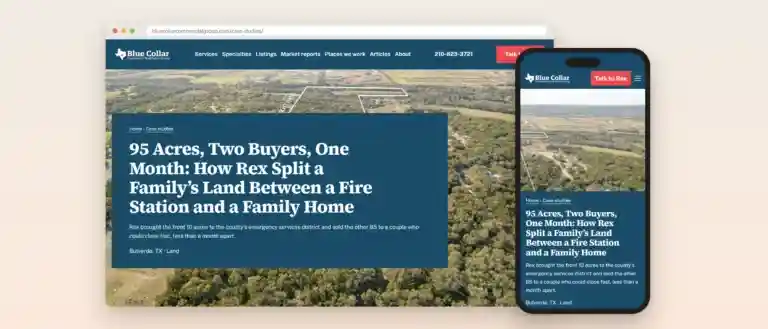
A track record is a dated account of assignments and the role you played. A case study adds the challenge, the approach and the result.
Both can help a reader assess your experience. Neither needs a deal value or a commission figure.
Focus on what you did. The property type and location help establish context, but the work is the part that explains your usefulness. Did you gather information, compare choices, market the property or coordinate a review?
Keep other people’s contributions clear. The fact that your firm handled an assignment does not automatically describe your individual role.
If you cannot share a client name or a detail, leave it out. Confirm that the remaining description is permitted and accurate.
Finally: Is reaching this person a chore?
Make the next conversation straightforward.
Put a working phone number and email address where the reader can find them. If a contact form is part of the route, keep the request easy to understand and test where the message arrives.
A prospect should not need to supply a complete property history just to ask whether you can help. You can gather more detail once the conversation starts.
Explain what information is useful at the beginning: the market, the property situation and the decision being considered. Avoid making the initial contact sound like an agreement to hire you.
Check the page on a phone. Someone returning to a voicemail may be using the same device to research you and contact you.
The same questions apply when AI does the reading
A prospect may ask a tool to summarize your work rather than open every page.
That makes the underlying facts worth checking. The tool can use old information or misunderstand a role. Its confidence is not an independent reference.
Ask for public sources. Read the linked pages. Compare the description with the current name, firm, services and work you know are accurate.
AI gets these details wrong all the time: old firms, wrong roles, team deals credited to one person. If your own page doesn’t spell it out, the chatbot will guess. And it guesses with total confidence.
You can correct the pages you control and request corrections elsewhere. You cannot dictate the answer.
The right goal is a clear source account that a prospect can examine directly. AI adds another reader. It does not change the facts you are responsible for publishing.
Inspect the record without inventing the owner’s motive
If the owner stays quiet, you do not know whether they searched you. You do not know whether the assignment is real, the timing is wrong or another advisor is already involved.
Don’t turn a website review into a story about that person’s decision.
You can identify a wrong email address. You can identify a missing service. You can see that a case study never explains your role. Those are defects you can fix.
Do this because a clear record is just good business. Not because someone promised you a magic callback formula.
Suppose an outside reader can identify you, explain why you called, find evidence of useful knowledge, understand completed work and contact you. The record has answered the basic questions. The owner still makes their own decision.
That is an honest test. It lets you improve the introduction without pretending the introduction controls the outcome.
Run the checks this week
Use the checks as a walk-through of the information you already have. You can do the first pass without buying a tool.
- Search the name you use on calls. Add your firm and market when needed. Confirm that the results lead to an accurate current identity.
-
Read the service description. Ask whether a property owner can see the reason you might contact them. Clarify the markets, client roles and work you genuinely cover.
-
Choose a useful answer. Review a market note or write a plain explanation of a question you often hear. Make the date and limits clear.
-
Open an account of completed work. Check that it identifies your role and explains more than the closing. Confirm the facts and permission to share them.
-
Try the contact route. Send a message or use the phone link from a mobile device. Make sure the intended person receives it.
- Ask a fresh reader to repeat the review. Let them tell you where they became uncertain. Fix that point before adding more pages.
Keep the notes specific. A page missing your current firm is an actionable finding. Saying the site needs to build more trust is too broad to tell you what to change.
Repeat the review when your practice changes. The information should stay aligned with the person making the call and the work you are willing to discuss.
What a failed check actually looks like
Say you ask a colleague outside the commercial team to review the site for a hypothetical landlord with a vacant office building in St. Louis.
The colleague finds the name and current affiliation immediately. Good. Then they look for landlord services and find a list of property types. They can see office. They cannot explain what you would do for the landlord.
That is the place to fix. Add a plain account of the landlord’s decision and the work you handle. Link to completed work that supports it, where permission allows.
Now suppose they reach a case study but cannot tell whether you advised the owner or the tenant. Fix the role. Don’t add another impressive photograph.
Finally they try the contact form. If the message disappears into an unmonitored inbox, repair the route before asking for more inquiries.
Each finding names a fix. “Build more trust” names a wish.
Write the findings down that specifically. A short list of observable defects is more useful than a long meeting about how the site feels.
Where UpliftCRE fits
The look-me-up moment drove my work at Blue Collar Commercial Group and eventually UpliftCRE. Our team’s public explanation needed to answer the questions that follow an introduction.
UpliftCRE combines a commercial real estate website built so prospects and AI can read it with an AI marketing staff that writes with you in ten-minute meetings. You explain the actual services, markets and assignments. You review each page you create before it publishes. On the Growth and Authority plans, Market Voice also publishes articles about your local market for you each week.
The pages can answer the questions in this inspection without making the owner reconstruct the practice. We help write and house the record. Your calls, judgment and follow-through still belong to you.
Frequently asked questions
Does every prospect check these things in this order?
No. This is a practical order for reviewing your information. It is not a measured sequence of prospect behavior.
What if another person has my name?
Use clear current firm, market and role information to distinguish your page. Check whether old or unrelated pages are creating confusion.
Should I list only a narrow specialty?
Describe the actual breadth of the practice. Explain the services and client roles clearly enough for a reader to assess the connection.
Does a closing announcement prove my experience?
It is a starting point. Your role and the work you did make it more useful.
Should I trust an AI summary of my career?
Check it against current public sources and your actual record. It can contain errors even when it sounds confident.
Can I tell whether the lookup caused a missed callback?
Silence alone does not establish that. Focus on concrete problems you can identify and correct.
Glossary terms used in this article
- Identity: The facts that establish which professional a page describes.
- Affiliation: The firm or organization with which you are connected.
- Market note: A dated explanation of a local observation and its relevance.
- Track record: A dated account of completed assignments and your role.
- Case study: A short explanation of a challenge, approach and result.
- Contact form: A page feature used to send an inquiry.
Sources: UpliftCRE CRE AI Visibility Pilot, 11,721 AI broker recommendations.