
TL;DR
- Investors don’t hire cheerleaders. They hire the advisor who asks the hard questions.
- Ask what they’re trying to do before you sell them a building.
- The offering memo is a sales pitch, not a fact sheet. Show that you know the difference.
- “I know this market” proves nothing. The questions your local knowledge makes you ask prove everything.
- Say what you don’t know yet. Investors trust the advisor who names the gaps.
The investor checked you before opening the meeting
You sit down with an investor in Atlanta after a referral. The investor has read your biography and found an account of your work.
Now comes the useful question: what would you examine before accepting the property’s story?
A page saying you know the market has not answered it.
An investor needs your questions more than your enthusiasm for the property.
Too many advisors pitch investors by reading the offering memo out loud with more excitement. Investors can read. What they can’t do is see the problems you’d catch.
At Blue Collar Commercial Group, our team’s best investor relationships started with a hard question, not a sales pitch.
A prospect should be able to examine some of that reasoning before the conversation. Put the useful questions on the record.
What is this investor actually deciding?
Ask about the objective before presenting a plan.
An investor might be considering an acquisition, examining an existing holding or thinking about a sale or lease. The building is part of the decision. It is not necessarily the whole decision.
Say, as a hypothetical example, an investor is examining a retail building in Atlanta. Interest in the property does not tell you the intended use, timing or information that would change the choice.
Ask what matters. Ask what is already known. Ask which assumptions still need support.
Your public account can explain that opening process. It should not prescribe an individual course of action from a generic article.
The client supplies the priorities. The engagement establishes the work. Your role is to make the examination clearer, not to replace the client’s decision with your excitement.
Which claims deserve checking?
An offering description is a starting account. Important statements need supporting information and appropriate confirmation.
Explain the work you do with that account. What do you gather? What do you compare? Which questions do you coordinate with another professional?
Gathering a lease is not the same as confirming everything it says. Seeing an access route is not the same as establishing the rights attached to it. Repeating a property’s stated use is not the same as confirming a proposed use.
Those are plain distinctions an investor can examine.
Keep your responsibility within the actual role. A lawyer, engineer or lender has work you should not claim merely because you helped coordinate the question.
A public explanation can show how you approach information without exposing a private assignment. It can also show that you know the difference between a statement and a supported conclusion.
That is a more useful demonstration of judgment than adding another adjective to the biography.
What does local knowledge make you ask?
Connect the town to a question that matters.
Say an example concerns a warehouse outside Atlanta. Local familiarity might help you identify an access question, an operational concern or information worth gathering. It does not establish the building’s suitability by itself.
Describe the observation and the next check. Don’t turn knowing the area into a conclusion about every property in it.
A market note is a dated explanation of an observation and its possible relevance. It can show part of your thinking while keeping property-specific confirmation in view.
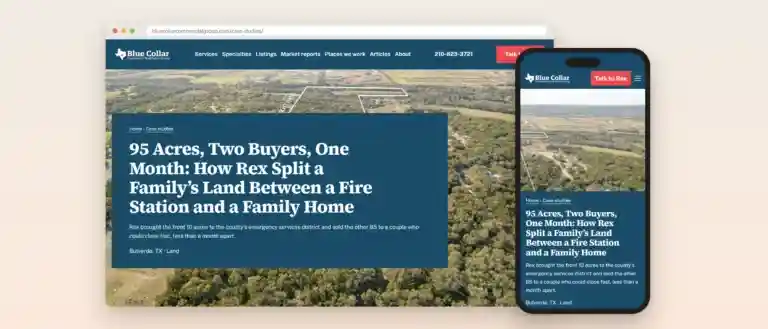
A case study can show the challenge, your approach and the result of actual work. Explain why that account is relevant to the current question and where the facts differ.
The matching photograph is not the proof. The reasoning and your contribution are what the investor can examine.
What remains unknown?
Keep the gaps visible.
An organized presentation can create a feeling of certainty before the information supports it. Do not make the investor discover the missing facts after reading a confident summary.
State what is known, what is inferred and what requires confirmation. Identify who can provide the needed answer.
An unresolved question is work to do. It should not disappear because a draft sounds better without it.
This applies to completed-work accounts too. If a concern remained, do not rewrite the history as though all uncertainty vanished. The result is what happened under those conditions.
You can be blunt about the gap and still be useful. The investor needs to understand the state of the decision, not simply receive a polished version of the original property story.
Describe the services you actually provide across the practice.
An investor may have questions about acquisitions, leasing, a disposition or another holding. You can explain the range without claiming that you personally handle every request.
A disposition is the sale or other transfer of a property interest. Use the plain explanation when it matters rather than expect every reader to recognize the term.
Keep direct work distinct from a referral, an introduction to another professional who may fit the need.
Explain how you organize information and next steps.
An investor may need to understand what has been received, what has been checked and which questions remain open. The exact communication arrangement belongs in the actual engagement.
Your public account can show a careful approach without promising a fixed response timetable you cannot sustain.
Use plain distinctions in examples. Gathering a document is different from confirming its claims. Identifying a concern is different from resolving it.
Choose what can be shared.
An investor’s goals, negotiations and other circumstances may belong in the private relationship. They are not automatically public material because the assignment would make an interesting article.
Explain the useful contribution at a permitted level. Check names, photographs and facts before publishing.
Give other participants appropriate credit. Do not make the investor look unreasonable merely to create a dramatic story of your intervention.
What can the investor establish about you?
The public record should make the current role, services and evidence easy to inspect. AI can provide another route to that background, but its list is not a hiring verdict.
In the UpliftCRE CRE AI Visibility Pilot, only 2.5% of identical repeated questions returned the same list of brokers. The Pilot covered 11,721 AI broker recommendations.
An investor who relies on one AI list is rolling dice. A smart investor checks the advisor’s own record. Make sure there’s one to check.
Ask what the investor has read and which question matters. Inspect available sources behind important claims. Correct a misleading description of your own work where you control the information.
Then return to the actual engagement: the objective, property facts, responsibilities and capacity.
The record should help the investor examine your approach. It should not ask a machine’s favorable description to do the examination for them.
Put your checking approach on the record this week
Prepare evidence of judgment rather than a larger collection of claims.
- Write the initial questions. Ask about the objective, the property situation and the decision being considered.
-
Explain your checking role. Describe how you organize information and identify questions. Keep specialist opinions separate from your contribution.
-
Select relevant work. Choose a permitted account that shows the reasoning needed for the conversation. Explain the connection and the differences.
-
Keep uncertainty visible. Mark what the account establishes and what would need checking in a new assignment.
-
Review privacy and current fit. Confirm permissions, responsibilities and the services you actually provide.
- Ask a reader what they learned. Have them describe the work and the remaining questions. Revise where the page creates a broader expectation than the facts support.
Use the account as background for a real conversation. The investor’s answers should shape the next step.
The record has done a useful job when it makes your approach assessable and helps the reader ask informed questions. The property decision remains individual, with its own facts and responsibilities.
Make the distinction visible in an example
Use a hypothetical commercial building in Atlanta. The property description makes a statement about how the space can be used.
A useful advisor account does not simply repeat the statement. It explains what information supports it, what the investor intends to do and who needs to confirm that particular use.
The point is not to pronounce the building unsuitable. The point is to avoid treating a statement as confirmation.
The same pattern applies to your marketing. A completed assignment says work happened. A case study explains your role and actions. A broad firm claim does not establish the contribution of the person whose page the investor opened.
Put that contribution in ordinary words. If you coordinated the information, say so. If another team member handled the representation, keep that role attached to them.
The investor can then assess what your practice actually provides.
Show the range where it is accurate: acquisitions, owner work, tenant questions and referrals. A referral is an introduction to another professional who may fit the need. It is not a way to absorb that professional’s experience into your biography.
Breadth helps the conversation when the responsibilities remain clear. It does not mean accepting every assignment or supplying every specialist opinion.
The standard is the same for the property story and the advisor story. Identify the statement. Examine the evidence. Keep the gap visible. Let the client make a decision with the actual facts.
Where UpliftCRE fits
I built UpliftCRE after working on the public account of our own firm, Blue Collar Commercial Group. The record needed to explain the team’s approach, not merely display completed properties.
UpliftCRE pairs a commercial real estate website built so prospects and AI can read it with an AI marketing staff that writes with you in ten-minute meetings. You bring the actual work, questions and confirmed facts. You review each page you create before it publishes. On the Growth and Authority plans, Market Voice also publishes articles about your local market for you each week.
The staff helps turn that knowledge into clear pages and case studies. Those accounts can support an investor’s examination of your practice. The individual property decision remains work you handle through the actual engagement.
Frequently asked questions
Do all investors want the same advisor qualities?
No. Ask about the actual decision and process. Use the public record to explain the work you can provide.
What should a case study demonstrate?
Show the challenge, your contribution and the result. Explain what is relevant to the current question without predicting a repeat.
Does local knowledge replace property-specific checking?
No. It can help identify questions worth examining. The actual property still needs its own work.
Can I describe several services?
Yes, if the range is accurate. Separate direct work from referrals and other professionals’ responsibilities.
How should I handle an unsupported AI claim?
Examine the source where available and state what remains uncertain. Do not treat fluent wording as checked evidence.
Glossary terms used in this article
- Market note: A dated explanation of an observation and its possible relevance.
- Case study: An account of a challenge, approach and result.
- Disposition: A sale or other transfer of a property interest.
- Referral: An introduction to another professional who may fit a need.
- Engagement: The agreed work and responsibilities in a client relationship.
Sources: UpliftCRE CRE AI Visibility Pilot, 11,721 AI broker recommendations.