
TL;DR
- When the listing dies, the proof shouldn’t. Kill the ad. Keep the story of your work.
- Sold should look sold. Nothing kills trust faster than a “now available” page for a building that closed last year.
- Listing sites rent you a page. Your site is the one you own. Use both. Keep your history on yours.
- Share what you did, not the private file. Your role and the result are enough.
- Click your old links. Someone will. Make sure they land somewhere useful.
The old link opens an empty page
An owner in Tampa asks about a warehouse your team handled nearby. You find the old link in an email and send it.
Then you click it yourself.
The offering is gone. So is the explanation. The owner now has your name and a page that does nothing with it.
Deleting the listing should not delete the evidence that you did the work.
Most of our industry runs on this habit: property sold, page deleted, move on. I think it’s one of the dumbest habits we have. You finished the deal. You didn’t stop having the experience.
At Blue Collar Commercial Group, I look at this from the marketing side. Our team does the property work. My job is to help make the account of that work understandable after the prospect goes looking.
An advertisement can expire. Evidence needs a different ending.
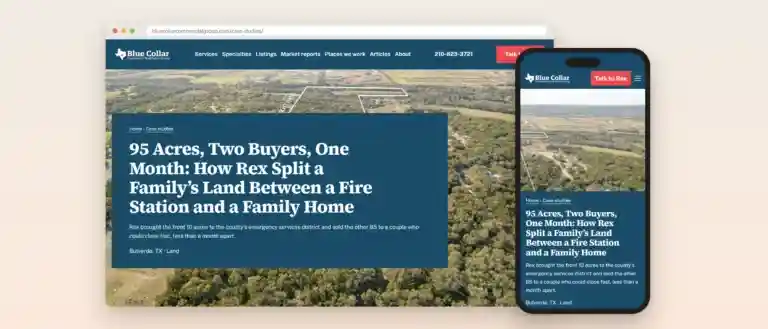
The page gets a new job
An active listing answers a property question: is this available, and does it fit what I need? A completed-work page answers an advisor question: what did this team do, and what can I learn about its approach?
Those are different jobs. Do not leave the old page pretending otherwise.
Say you helped an owner sell a retail building in Charlotte. During marketing, the page described the building and how to inquire. After the sale, the account should explain the assignment, your role and the outcome you can share.
The tour invitation comes off. The completed status goes on. The actual work becomes the subject.
Perhaps existing tenancy required careful preparation. Perhaps the owner needed to sort property information before discussions. Explain the question and the approach, with facts checked against the file.
The building may have a new owner. Your work still happened. A prospect examining you next month should be able to understand that without wondering whether the building is still on the market.
Keep using the portals. Keep your own history too.
Keep using the channels that suit the assignment, including the big listing sites. Just understand that a page on another service follows that service’s rules.
A listing may be retained, removed, changed or reached differently after its status changes. The outcome depends on the service and the account. Check it rather than assume a universal policy.
A firm website can change too. A redesign, a change in staff or a change of platform may affect old pages.
That makes a separate, approved account on your own site useful. An owned domain is a web address under your control. It gives you a place to maintain the history subject to your permissions and obligations.
What stays, what changes, what leaves
Keep the property context that explains the assignment. Keep the date. Keep your role. Keep an accurate account of actions and the permitted result.
Change the headline and the opening so the page clearly describes completed work. Change present-tense claims about the property into dated statements about the assignment. Conditions can change after you leave.
Remove availability language, invitations to tour under the old assignment and anything private or restricted.
Say an example account concerns an office building in Denver. During marketing, you described a tenant’s current use. After the assignment, that description belongs in the history only if it matters and you can share it. It should not read as a promise about current occupancy.
This is a rewrite, not a closed stamp pasted over an advertisement.
A short, true page beats a long page where half the sentences stopped being true. One gives the owner proof. The other makes them dig through your old ads.
The public page is not the transaction file
Preserve your required business records according to the rules that apply to your practice. A public page is a different thing.
It does not need private financial information, negotiations, personal details or documents shared for a limited purpose. Keeping those materials out does not prevent you from explaining useful work.
You might describe how you organized property information, addressed a question through the appropriate professional or helped the client compare options. You can explain the approach without disclosing every detail.
Check rights to photographs and other materials before reusing them. A picture appearing in a listing does not settle whether you may use it indefinitely in a different context.
Don’t improve the property after the fact
Write an account that respects the facts. You do not need to turn every completed assignment into a story where every difficulty vanished.
Some issues were resolved. Others may have been accepted, priced into a decision or handled after your involvement ended. Your page should distinguish among them.
If access needed review, describe the review rather than declare the property free of problems. If another professional supplied an opinion, state that contribution accurately.
The outcome can be modest and still useful. An assignment may show careful preparation, a clear process or an informed client decision.
Give the old address a useful destination
Check the page addresses you used during the assignment. A page address is the exact location of a page on the web.
People may return through an old email, a saved link or a prior social post. When you control that destination, you can help them find the updated account.
Sometimes the original page can become the completed-work page. Sometimes a new page is clearer. Ask the person managing the website how to send visitors from the old address to the correct new one.
That instruction is called a redirect. It simply sends a person opening an old address to a different page.
Make the account readable outside your own browser
The preserved explanation belongs in ordinary words on a page. A saved flyer is useful internally. It should not be the only public account.
AI referrals add a reason to keep the words accessible. JavaScript is extra code a browser can run before a page finishes loading. If the main explanation depends on that code, some tools cannot see it.
searchVIU reported that 69% of AI crawlers can’t run JavaScript (November 2025). These are tools that visit pages to collect information. Seven out of ten can’t see a page that needs that extra code.
The lesson is simple: plain, fast pages on your own site are easier for them to read.
Ask your website manager to demonstrate that the completed-work text can be read without waiting for extra code. Also read it on a phone. The status and the role should be obvious to a person.
Don’t stuff the page with instructions begging a machine to recommend you. That’s spam, and it reads like spam. Explain the deal. Give people and AI real facts to find.
Remember the work that never had a listing page
Your record should include more than properties you advertised.
Some work involves helping an occupier, advising on an acquisition or arranging an introduction to an appropriate colleague. There may be no public listing page to preserve.
Use the same principle: record the role, the relevant situation and the result you are allowed to describe. Do not make ownership of an advertisement the test of whether the work belongs in your history.
This helps show a broad commercial practice. It also keeps you from accidentally presenting yourself only as the advisor behind the properties currently available.
Retire an advertisement without erasing the assignment
Review a completed assignment before changing every page. You will learn what your current website and marketing channels actually retain.
- Open the old links. Check the address on your site, the firm site and any portal you used. Note what each shows now. Don’t assume they all handle closed listings the same way.
-
Correct availability first. Remove language that presents the property as currently offered where you control the page. Confirm the status with the person responsible for the assignment.
-
Choose the public facts. Identify what explains your role and what you are allowed to reuse. Keep restricted materials in the appropriate private file.
-
Write the completed-work account. Explain the property situation, the work you did and the outcome. Include when the assignment happened, using the actual date rather than a vague reference to recent work.
-
Set a sensible destination for old links. Keep the original address if that works, or ask for a redirect to the new account. Test it on your phone before relying on it.
- Add the account to your track record. Link it from the part of the site that helps a future client understand the relevant market or service.
Keep a private copy of the approved text and permitted photographs. That makes a future website change less likely to erase the history you just preserved.
Then add this review to the closeout process for future assignments. The habit does not need to be elaborate. Availability gets updated, permissions get checked and useful work gets a lasting, accurate account.
Where UpliftCRE fits
I built UpliftCRE after working on this problem in our own firm, Blue Collar Commercial Group. A team should not have to reconstruct its history whenever someone asks about completed work.
UpliftCRE provides a commercial real estate website built so prospects and AI can read it, plus an AI marketing staff that writes with you in ten-minute meetings. You explain the assignment, the role and the facts that may be shared. You review each page you create before it publishes. On the Growth and Authority plans, Market Voice also publishes articles about your local market for you each week.
The website gives the completed account somewhere to stay. The writing staff helps change its job from selling an available property to explaining the work your practice actually did.
Frequently asked questions
Do listing portals always remove sold properties?
No universal rule applies across services and accounts. Check what happened to the specific page you used.
Should I delete a closed listing from my site?
End the active offering clearly. Where appropriate, preserve a dated account of the completed work instead of leaving stale marketing language.
Can I reuse all the listing photographs?
Check the rights and permissions first. Prior use in marketing does not settle every later use.
What is a redirect?
It sends someone opening an old page address to another page. Ask your website manager to use a relevant destination and test it.
Should a completed-work page include private terms?
Only share what you are allowed to disclose. You can explain your approach without publishing private negotiations or client documents.
What about an assignment without a public listing?
It can still belong in your record. Describe your actual role, the situation and the permitted outcome.
Glossary terms used in this article
- Active listing: A property currently being offered under a marketing assignment.
- Completed-work page: A dated public account of an assignment that has ended.
- Owned domain: A web address under your control.
- Page address: The exact location of a particular web page.
- Redirect: An instruction that sends a visitor from an old page address to a different page.
- Track record: A record of completed work and the role you played.
Sources: searchVIU, November 2025, AI crawlers and JavaScript rendering.