TL;DR
- Your cold call doesn’t end when you hang up. It ends when the owner finishes looking you up.
- More dials won’t fix an empty website. You’re just sending more people to a dead end.
- Never send a naked link. Tell the owner what the page answers and why it matters to them.
- Don’t bet the introduction on ChatGPT. Its broker lists change almost every time you ask.
- “Did you get my email?” is not a follow-up. Bring a new reason or don’t call.
You leave the message. The owner opens a browser.
You leave a voicemail for the owner of a strip center outside Orlando. Good message. Clear reason for calling. Your name, twice.
Here’s what you may never see. Later that day, the owner might type your name into Google. Or asks ChatGPT, “Who is this person?”
Try it yourself. Search your name on your phone right now. Does the first page mention the work you just bragged about on the voicemail? Or is it a two-line profile and a headshot from 2019?
You practiced the call. You never practiced the part that happens after it.
Your cold call is only half the pitch. The lookup is the other half.
The sales trainers will tell you a slow week means you need more dials. I disagree. If the lookup falls flat, more dials just send more people to the same dead end.
At Blue Collar Commercial Group, I run the marketing and technology side. Our team learned this the expensive way: great calls, quiet phones. We decided to fix the part we could control: what the owner found afterward.
Count the lookup as part of preparation
Before contacting the owner, decide what they can learn if they check you. That is part of preparing the contact, not an optional website project.
A call gives the prospect a name and a reason. An email gives them a link. A letter gives them something to keep. Each can lead to a search without a reply.
The mistake is treating silence as proof that nothing happened. You don’t know whether the person researched you. You also don’t know whether they had a need. Fix what you can observe.
Open the page you expect them to find. Does it support the reason you are calling? Does it explain your role and current firm? Is the contact route usable?
Say you are contacting warehouse owners around Kansas City about preparing property information before a sale or lease. Your landing place, the page carrying the explanation, should address that preparation.
A generic home page with a list of property types is not the same thing. It makes the owner finish your introduction for you.
The call and the page must tell the same story
The short message must stay inside what the fuller account supports.
Say you mention work with a tenant outside Dallas because it explains your understanding of industrial space. The page should describe that tenant work, including the role and timing. Don’t let the call imply that you represented the owner if you did not.
If the assignment belonged to a team, say so. If it happened under a previous firm, preserve that context. A polished introduction should not spend credit the record cannot repay.
This also applies to local knowledge. Calling yourself a local expert is a claim. An explanation of the access questions affecting a particular area gives the owner something to examine.
Use the page to carry detail the message cannot. Use the message to say why that detail matters.
A person moving between them should meet the same practice. If the page shrinks the claim you made by phone, the page is not the problem. The claim needs fixing.
Say why this page is worth opening
Explain what the page answers before you send it.
A bare website address asks the prospect to do the sorting. A short explanation can connect the page to the point of the conversation.
For example, you might share an account because it explains how missing property information was gathered before marketing. That is a useful reason to read. The connection should be real, not merely a pretext to send something.
You do not need to manufacture urgency. A person can read the account now, save it or ignore it. Their timing remains theirs.
Let relevance do the work of the invitation. Send a page that answers a question or explains a concern the owner may reasonably have.
Send the answer, not the whole library
Choose the smallest amount of material that helps the conversation.
A property owner may not need your entire career history. They may need an account of how you handled a particular issue or an explanation of what to prepare before meeting.
A case study is a short account of a challenge, your approach and the result. A market note is a dated explanation of a local observation. Either can be useful when it fits the reason for contact.
The page can offer routes to the broader record for someone who wants more. That is different from making the first message carry a reading list.
Leave room for the owner’s actual situation
A warm conversation, in this context, is a better-informed conversation. It is not a prediction that someone is ready to hire you.
A prospect who has read an account may understand your role and have more specific questions. They may also decide the work does not fit what they need.
That is useful information. The purpose of background is to help someone assess fit, not to corner them into a response.
You still need to ask about their plans and listen to the answer. A website cannot tell you whether the owner wants to sell, what matters to the business or who else is involved in the decision.
Don’t strand the reader at the bottom of the page
Keep your identity and contact details clear on the page you share.
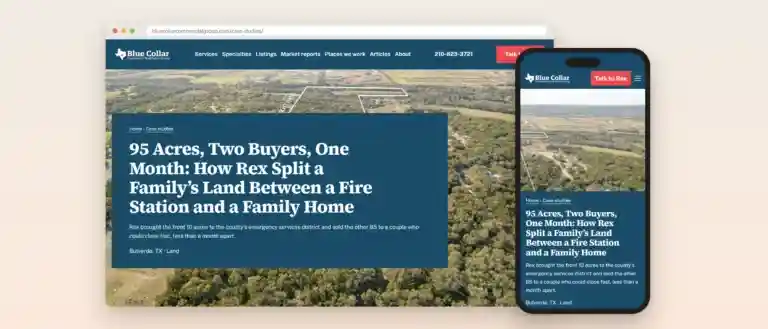
A reader arriving through a case study should not have to return to the home page to establish who wrote it or how to reach you. State the advisor’s role and link to a useful introduction.
Show the next step in ordinary language. A discussion about the property situation is easier to understand than an invitation to experience a comprehensive solution.
Check the page on a phone. Test the email and phone links. If you use a contact form, send a test message and confirm where it arrives.
Don’t make the machine your closer
An owner may use AI to research the name instead of opening your link. That is another route you should understand. It is not a reason to outsource your explanation.
In the UpliftCRE CRE AI Visibility Pilot, only 2.5% of identical repeated questions returned the same list of brokers. The Pilot examined 11,721 AI broker recommendations.
So ninety-seven times out of a hundred, the list changed. That screenshot of you on ChatGPT’s “top brokers” list? Don’t build your pitch on it. Next time, you may not be there.
Check what AI says about your practice and the pages behind the answer. Correct wrong facts in your public record. Keep your actual message tied to work you can support.
When you have a relevant account, send the account. Explain why it matters. A direct link lets the person inspect that page rather than depend on a changing recommendation list.
Send your own page. You control it. You don’t control the chatbot.
Follow up about the property, not your email
The next contact needs a reason beyond asking whether the person saw the last contact.
Say your page explains preparation for marketing a small office building. The follow-up can ask about the owner’s intended use or timing and whether that preparation issue applies. It should not become a reading-comprehension test.
If you shared an account of completed work, explain the relevant question and the difference between the old assignment and this property.
The owner doesn’t owe you a reply or a book report. Your job is to make every touch worth their time.
Keep the sequence grounded: a real reason, a page that supports it, then a question that moves the subject forward. If you run out of substance, do not substitute volume and call it persistence.
A better-informed conversation is what warm means here. It is not a promise that the owner will return the call. That distinction lets you improve the work without pretending you control the person.
Fix a contact sequence this week
Connect an outreach message to a useful page before redesigning your entire prospecting process.
- Choose a real reason for contact. Start with a property question, local observation or assignment relevant to the owner. Keep the reason accurate and within what you can support.
-
Find the page that explains it. Use an existing account if it fits. If it doesn’t, write a clear explanation from the facts rather than send an unrelated page because it looks impressive.
-
Compare the message with the page. Check that your role, the timing and the claim agree. Remove anything in the message that the fuller account cannot support.
-
Test the route a prospect would take. Search your name and open the page on a phone. Confirm that the reader can identify you, understand the context and find your contact information.
-
Send the link with a plain explanation. State why it is relevant to the question. Give the person enough context to decide whether reading it would help.
- Prepare the next useful question. Think about what you would ask if they respond. Let their actual situation guide the conversation rather than reciting the case study back to them.
Keep a note of what material you used and what you learned in subsequent conversations. You may discover that a page raises a useful question or that the connection was weaker than you thought.
Use what you learn to sharpen the next message. Then do the one thing no web page can do for you: listen.
Where UpliftCRE fits
I built UpliftCRE because our team at Blue Collar Commercial Group needed the record behind its outreach to be clear and usable. The website had to carry more than our names.
UpliftCRE provides a commercial real estate website built so prospects and AI can read it, plus an AI marketing staff that writes with you in ten-minute meetings. You bring the assignment, the local question or the reason for contact. You review each page you create before it publishes. On the Growth and Authority plans, Market Voice also publishes articles about your local market for you each week.
The finished pages give your outreach somewhere relevant to point. You still decide whom to contact, ask the next question and listen to the owner’s answer.
Frequently asked questions
Does a stronger record mean more callbacks?
It can give someone better background, but it cannot determine their response. Their need, timing and preferences still matter.
Should every message include my home page?
Use the page that best supports the reason for contact. The home page can be useful when it provides the needed introduction.
What makes a link relevant?
It answers a question or explains an issue connected to the conversation. A similar property photograph alone may not establish that connection.
Should I ask whether the prospect read the page?
You can discuss the subject without treating reading as an obligation. Focus on whether the issue applies to their situation.
What if AI describes my work incorrectly?
Check the sources behind the description where available. Correct public information you control and avoid repeating the error.
Can I use this across different client roles?
Yes. Choose the account that fits the owner, occupier or investor’s question. Keep the broader practice available for anyone who wants more background.
Glossary terms used in this article
- Outreach: Contact you initiate to begin or continue a business conversation.
- Landing place: The page carrying the explanation behind your introduction.
- Case study: An account of a client problem, the approach and the result.
- Market note: A dated explanation of a local observation.
- Follow-up: A later contact intended to move a relevant conversation forward.
- Public record: Information about your work that others can read openly.
Sources: UpliftCRE CRE AI Visibility Pilot, 11,721 AI broker recommendations.