

TL;DR
- The big national firms don’t own AI’s answers. Our research shows it.
- In smaller markets, their grip loosens. Their share falls from 68.3% in the 20 biggest metros to 35.4% in metros ranked 51 and up.
- Even CBRE can’t lock the #1 spot. It was #1 sometimes, but it never held the top spot every time in any of the 237 market-and-property-type combinations we tested.
- This isn’t a knock on national advisors. It’s proof the door is open for everyone else.
- Local advisors win by writing down their local work. Specific, checkable, current.
You look at the national logo and give up
You’ve got a meeting next week with an owner in Columbus, Ohio. You find out the other advisor in the running works for one of the giant national firms.
You pull up their website. Polished. Famous logo. Offices everywhere. Then you pull up yours. Your best local work is still sitting in a file cabinet.
It’s tempting to think the game is over before it started.
It isn’t. The biggest national firms do not own AI’s broker lists. We checked.
This isn’t an attack on national firms or the advisors who work there. Many of them are excellent. It’s an attack on the belief that a famous logo automatically wins.
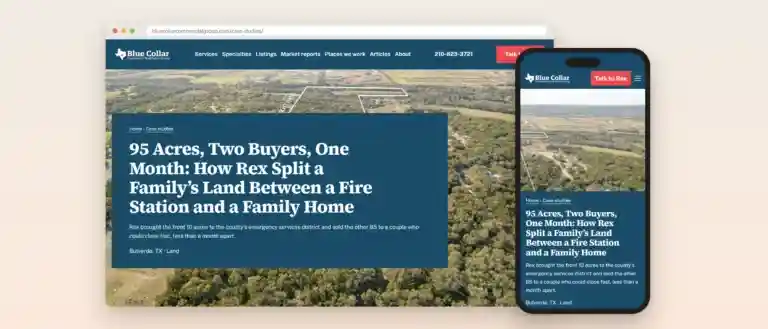
I’m a partner at Blue Collar Commercial Group, a KW Commercial team in Texas. We compete against the national firms every week. So I wanted real data, not a hunch. Here’s what we found.
A prospect checking a referral should be able to understand the advisor’s role, not only the firm’s reputation.
National firms can offer resources and experience that matter to an assignment. Local firms can have relevant knowledge and relationships. Neither general description settles which advisor fits the actual engagement.
Give the owner something more useful than a logo comparison: the services, market context, completed work and responsibilities you can accurately describe.
AI referrals come after that first job. A person starting without your name can ask for advisors. Your public account gives the tool something to find; it does not instruct the tool whom to include.
The distinction keeps the work grounded. You are explaining a practice, not trying to prove that one class of advisor is better than another.
Finding: the largest firms’ share changed with market size
In the UpliftCRE CRE AI Visibility Pilot, the biggest national firms’ share of recommendations fell from 68.3% in the 20 biggest metros to 35.4% in smaller markets, metros ranked 51+. The Pilot covered 11,721 AI broker recommendations.
A metro is a city plus its surrounding area. These numbers are about AI recommendations, not deals closed or how good anyone is.
In the biggest cities, the national names take about two out of every three AI recommendations. In smaller markets, that drops to about one in three. The rest goes to everyone else.
That’s not a promise your name shows up. Nobody can promise that. But it kills the excuse. If you work in a smaller market (metros ranked 51 and up), almost two out of three recommendations go to someone other than the biggest national firms. The question is whether AI can find enough about you to be one of them.
Finding: CBRE did not keep an uninterrupted top position
CBRE did not hold the #1 spot every time in any of the 237 market-and-property-type combinations tested. It was #1 sometimes.
Let me be precise, because precision matters here. CBRE showed up plenty. It was #1 sometimes. But ask the same question again and the top spot moved. In not one of 237 combinations did the best-known name in our business hold #1 every single time.
This says nothing about any CBRE advisor’s skill. An AI list is not a performance review.
What it says is simple: nobody owns the top of these lists. Not the biggest brand on earth. And not you either, even when you do show up.
The Pilot is first-party research, research conducted by the organization presenting it. The research is ours, and that deserves disclosure.
We asked four AI tools about 79 metro areas and three property types, over and over. These findings describe what those tools said. They don’t prove that building a website gets you named. Anyone who tells you that is selling something.
What the data does show: the idea that a brand name is a lock doesn’t hold up.
Put the local work where it can be examined
A smaller firm’s account needs substance, not louder claims.
Say you help an owner consider a warehouse outside Columbus. This is a hypothetical example. Explain the practical questions: access, the intended use, the information needed before marketing and the owner’s timing.
Then describe work you actually performed in a permitted case study, a short account of a challenge, approach and result. The property type and town establish context. Your actions establish the contribution.
Do not declare yourself the local alternative to a national firm and stop there. The reader still needs to know what you do.
A useful public account can show where local knowledge led to a question worth checking. It should keep the distinction between observation and confirmation.
If another professional provided an opinion, state that. If the client chose a course of action, keep the choice attached to the client.
A careful description gives the prospect something to examine before the conversation. An insult about a competitor gives them a different reason to question your judgment.
Show the actual breadth of the practice.
You might handle owner work, tenant searches and acquisitions, with referrals where appropriate. Explain those roles instead of allowing a current warehouse listing to define the whole business.
Say you also help a tenant think about office space downtown. The reader should be able to find that explanation from the broader introduction. A visitor arriving through industrial work should not have to assume you do nothing else.
Breadth does not excuse vague writing. Each service needs a client need, a role and a route to relevant evidence.
You can assess a wider range of questions while staying selective about which assignments you accept. The website explains the range. Your judgment determines the fit.
Keep the main words on readable pages under an address you control.
Explain the current name, firm, role, markets and services together. Connect completed-work accounts to relevant explanations. Date historical material and keep status clear.
A list of towns does not establish useful local knowledge by itself. Explain why a particular local question matters to the work.
The website manager can check the technical delivery. Your job is to check whether a stranger can understand the account without knowing you.
This helps the prospect who already has your name first. It also gives AI material it can potentially use in a broader search.
The tool can omit it or misunderstand it. The public explanation still serves the person opening the page directly.
Give a referral source something specific to share.
A colleague who knows your work may be able to explain the connection personally. A clear page lets that explanation travel without relying entirely on their memory.
Choose the account that fits the question. An owner-preparation page belongs in a different conversation from a tenant’s operational requirements.
Keep the broader record available. Do not send every account simply to demonstrate that the firm has been busy.
A referral is an introduction to another professional who may fit a need. Where making that introduction is your own role, describe it accurately. Do not borrow the receiving advisor’s expertise.
The record and the relationship can support each other. A national affiliation can support them too. None needs to pretend it is the whole explanation.
Test facts without turning the answer into a scoreboard
Start with a named lookup about your current practice. Ask for public sources and compare the account with facts you know.
Check a wrong firm, overstated role or missing service explanation. Correct information you control and request specific changes elsewhere.
If you also inspect recommendation lists, keep the exact wording and answer. Record the date privately. An appearance belongs to that observation. An omission does too.
Do not rerun the question until a favorable answer becomes the only screenshot you keep.
Apply the same fairness to other names in the response. You have observed a tool’s list. You have not evaluated another advisor’s actual work.
The goal is a clearer record, not a screenshot that says you won the internet.
Put the evidence to work this week
Begin with your own public explanation before comparing the size of websites.
- Write the current practice account. State the firm, role, markets and services. Keep direct work and referral work distinct.
-
Choose a local question worth explaining. Use a permitted assignment or an accurate preparation answer. Let the work supply the topic.
-
Attach the actual contribution. Confirm who did what, when it happened and what outcome may be shared. Leave private materials out.
-
Connect the page to the broader practice. Give owners, tenants, buyers and investors clear routes to the relevant work you actually provide.
-
Use it in an introduction. Explain the connection to the prospect’s question. Do not let the earlier result become advice about an unexamined property.
- Check the AI description factually. Inspect sources and record unresolved points. Keep recommendation observations separate from professional judgments.
This is work an advisor can do without choosing a vendor. The Pilot gives you a reason to question an assumption. Your own record gives you something to improve.
A national logo is a fact about affiliation. A local contribution is a fact about work. Explain both accurately and let the client examine the fit.
Where UpliftCRE fits
The problem in our own firm, Blue Collar Commercial Group, helped lead me to build UpliftCRE. Local work needed a public account that did more than repeat an affiliation.
UpliftCRE pairs a commercial real estate website built so prospects and AI can read it with an AI marketing staff that writes with you in ten-minute meetings. You explain the actual markets, services and contribution. You review each page you create before it publishes. On the Growth and Authority plans, Market Voice also publishes articles about your local market for you each week.
The staff helps put that evidence into clear pages. The product does not control a recommendation list. It helps give the work an account a person or tool can find and examine.
Frequently asked questions
Does the Pilot judge advisor quality?
No. It describes AI broker recommendations in a tested sample. An individual’s professional work needs a different assessment.
What changed between the market groups?
The biggest national firms’ share was lower in the smaller-market group than in the biggest metros. That concerns recommendation share, not completed deals.
Does the CBRE finding mean the firm was absent?
No. It was top-ranked sometimes. The finding concerns whether it held that position without interruption in the repeated tests.
Does the research prove a website change causes inclusion?
No. The findings do not establish that causal connection. Clear pages give the tool material it can potentially find.
Should I hide broader services to compete?
Describe the actual practice. Keep the range specific and distinguish direct work from referrals.
What should a local advisor improve first?
Start with the account a prospect checking a referral can read. Clarify the current role, markets, services and evidence of work.
Glossary terms used in this article
- Metro: A city and its surrounding metropolitan area.
- First-party research: Research conducted by the organization presenting the findings.
- Recommendation share: The portion of recommendations assigned to a defined group in a sample.
- Methodology: The process used to collect and interpret research.
- Case study: An account of a challenge, approach and result.
- Referral: An introduction to another professional who may fit a need.
Sources: UpliftCRE CRE AI Visibility Pilot, 11,721 AI broker recommendations.