
TL;DR
- “Just closed!” is not a case study. It skips the only part a prospect cares about: what you did.
- Facts first, writing second. Make a quick fact sheet before you write a word.
- Verbs beat adjectives. “Checked the truck access” beats “provided exceptional service” every time.
- Tell what happened. Don’t promise it’ll happen again. A result is history, not a forecast.
- AI can write the draft. It can’t supply the facts. Delete anything it made up.
You have the photo. The owner wants the explanation.
You are preparing a follow-up for an owner in Nashville. The owner asked about work like theirs. You have a closing photograph, an announcement and a memory of the difficult part.
The difficult part is the useful part. It is also missing from the page.
Your closing announcement is not a case study.
A closing announcement says something ended. A case study explains the problem, the approach and the result. A stranger checking you needs the second account.
Every week I see advisors post the handshake photo, the SOLD sign and a caption that says “Another one closed!” Congratulations. Nobody learned anything.
You don’t need a bigger deal to have something worth writing. You need to stop skipping the part between the first meeting and the photo. That’s where your value lives.
Choose the assignment for its question, not its photograph
Pick work that shows a decision, a problem or a practical contribution. The largest or most photogenic property may not be the best choice.
Think about questions prospective clients ask. An owner may wonder how to prepare before marketing. An occupier may need to connect a location decision with business operations. An investor may want to understand how you check the information presented.
Choose an assignment that helps answer a question you actually hear.
Then confirm that you can discuss it publicly. Review permissions, confidentiality and the rights to any supporting materials. If those are unresolved, keep the draft private.
Build the fact sheet before the story
Make a plain fact sheet for yourself. This is a private working note, not the finished page.
Include the property situation, location, client role, assignment timing and your role. Record the result and the materials that confirm it. Mark anything you still need to check.
Separate facts from interpretation. You may know that an issue was examined. Saying that your action caused the closing may require evidence you do not have.
Also separate your work from the team’s work. If another advisor, attorney or specialist handled part of the process, write that down while the record is clear.
Begin with the client’s decision
Tell the reader what the client needed to accomplish and what made it difficult.
A property owner might need to decide whether to market immediately or clarify information first. An occupier might need to compare suitable spaces without losing sight of access and operations.
Those are hypothetical situations, not accounts of named clients. Your published case study should use the actual circumstances of the assignment you selected.
Avoid describing the client as confused or the property as hopeless. The account should respect the people involved. Difficulty is context, not an opportunity to make yourself look heroic.
The reader can examine whether the situation resembles their own. Keep the opening grounded in the client’s problem instead of your enthusiasm about the closing.
Write verbs someone can picture
Gathered. Compared. Checked. Explained. Coordinated. Introduced.
Those verbs do work. Provided exceptional service does not.
Describe the action, then its reason. If you gathered property information, say which question it answered. If you compared alternatives, explain what made the comparison useful to the client.
Say you helped a business evaluate warehouse options outside Phoenix. Comparing asking terms was part of the job. Checking whether the loading arrangement fit the business may have been another. That second detail explains judgment the first sentence cannot.
Do not make the account more dramatic than the file. Coordinating a review is not providing the engineering opinion. Explaining options is not making the client’s decision.
Team work stays team work. A writer should ask who performed each action before choosing the subject of the sentence.
If you cannot point to what happened, the sentence needs checking. A polished verb does not make an invented contribution true.
Write the ending the file supports
Explain the outcome you can verify. Keep it specific enough to be useful and restrained enough to remain accurate.
The assignment may have ended in a sale, a lease, an acquisition or a decision to take another path. A closing is not the only result that can demonstrate useful work.
If an issue remained, don’t quietly erase it. Explain the outcome at a level appropriate for public use. Avoid claiming that the process eliminated every concern.
You can describe a completed transaction without a price or commission. The result is what happened, not a calculation of your importance.
Keep the lesson attached to this assignment
Give the reader a practical reason to remember the account.
A lesson might be that missing property information is worth identifying early. Another might concern the difference between a preferred location and the requirements of a business.
Keep the connection modest. The lesson comes from this assignment under these conditions. Another property may call for a different approach.
Say what a future client might want to examine, rather than prescribe a decision without their facts. The account should help them ask a better question.
Let AI help with the draft, never with the missing facts
In a February 2026 RPR survey of 225 agents, 92% said they use AI or plan to. Most of your competitors already have AI writing tools open. Use them. Just don’t let one fill in the holes of a deal you barely remember.
Give the tool your confirmed fact sheet. Ask it to organize the challenge, approach and result. If it adds a client motive, an action or a dramatic turning point you did not supply, remove it.
A draft can sound convincing while inventing the part you most need to verify. That is why the facts come first.
Put the finished explanation directly on a readable web page. Give it a title that names the market and the work, a date and plain headings. Keep supporting downloads optional.
An AI tool researching you then has actual words to find. A prospect has an account to examine. Neither needs a folder of slogans.
Read the page out loud before you publish. If you wouldn’t say it across the table, it doesn’t go on the website.
Check facts before polishing sentences
Read the draft in separate passes. Each pass should ask a different question.
First, check whether the facts match the record. Then check whether the account can be shared. Finally, read it aloud and remove language you would not use in a client meeting.
Look closely at causal claims. Words that say your action produced the outcome need support. You can often write more accurately by explaining the action and the outcome without claiming sole responsibility for the connection.
Remove private details that do not help the public explanation. Confirm that photographs and names can be used.
Finish a real account this week
Finish an account before building a complicated writing process. You will learn what information is easy to gather and where permission slows things down.
- Choose a completed assignment. Pick a question worth explaining, not a transaction chosen only for its size. Confirm that a public account is appropriate.
-
Write the private fact sheet. Gather the property facts, location, role, timing, work and result. Note the source for each important detail and leave uncertain items marked for checking.
-
Draft the challenge. Explain the client’s aim and the obstacle in ordinary language. Use the facts of the actual assignment rather than inventing a more dramatic situation.
-
Draft the approach and result. Say what you did, why it mattered and what happened. Credit other contributions and keep the client’s decisions separate from yours.
-
Review with the right people. Check facts and permissions before the page goes live. A colleague who participated may catch something your memory missed.
- Publish and use the approved account. Give it a clear place in your record. Send it when it answers a question, with a short explanation of the connection.
If the draft feels flat, add the missing explanation rather than a stronger adjective. What was uncertain? What information helped? Why did a particular step belong in the process?
That is usually where the useful story is hiding. The best version may be quite plain. A prospect does not need entertainment; they need to understand the judgment behind the work.
A worked example: the warehouse search
This is a hypothetical example, not a client account. Say you helped a business looking for warehouse space outside Salt Lake City. The business wanted a particular location, but the move also needed to work for deliveries and storage.
Here is how to build the account without inventing a person, a quote or a deal value.
Challenge
Explain what the client needed and what complicated the decision.
The business needed space that supported its operations and move schedule. A preferred location did not settle whether the properties available there fit the work. Delivery access and the permitted use needed examination.
That is enough context to begin. Do not describe the owner as overwhelmed. Do not make a property sound impossible just to improve your entrance into the story. The client had a practical decision. Respect it.
In a real account, use only the requirements and concerns that actually existed. If storage was never an issue, it does not become one because it makes a better paragraph.
Approach
List the actions that belonged to you.
For this example, you helped organize the business’s requirements before comparing spaces. You examined the available information, brought operational questions into the comparison and coordinated confirmation of matters outside your own expertise.
That is still a little broad. A real account should add the permitted detail that explains the action. What loading requirement affected the search? Which information was missing? Who needed to confirm the proposed use?
The useful detail connects the work to the decision. It does not need to reveal private negotiations.
Keep the credit straight. If the client’s operations manager defined the loading requirement, say so. If another professional confirmed a use question, do not write as though you provided that opinion.
Result
Describe the outcome without turning it into a sales forecast.
For the example, say the business selected a space after comparing the operational requirements and arranging the needed confirmation. That describes a decision. It does not claim the property was perfect or that your next tenant assignment will follow the same path.
In a real account, the result must match what happened. The business might have stayed put. It might have delayed the move. Either can demonstrate useful work if the account explains the decision accurately and can be shared.
A funded closing or a signed lease is not the only ending worth documenting. An informed decision is part of the practice too.
The lesson
Keep it narrow enough to defend.
The lesson in this example is to establish operational requirements before treating a preferred address as a complete answer. It is a question a future client can examine, not a rule that one location is wrong.
Now read the example as a property owner, a tenant and an investor. The tenant sees how you connect space to operations. The owner sees the questions that can affect tenant fit. The investor sees an account that distinguishes preference from confirmed information.
That is breadth through actual explanation. You did not need to label yourself a specialist in everything.
The finished case study should still be short enough to use. Remove facts that don’t explain the challenge, action or result. Keep the facts that make the reasoning visible. A future reader should finish with a better question, not just your logo lodged in their memory.
Where UpliftCRE fits
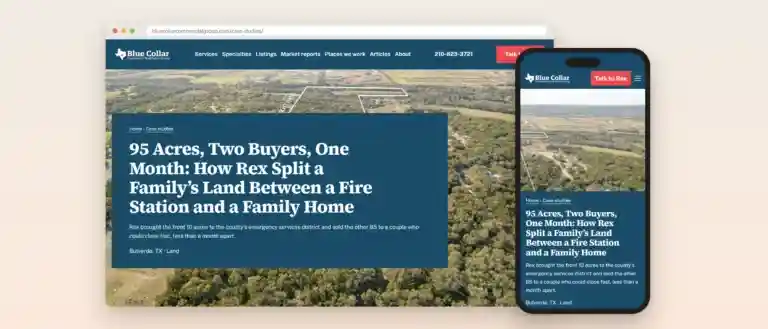
Case studies were part of the problem we worked through at our own firm, Blue Collar Commercial Group. The knowledge was in the team. Getting an accurate account written was another job.
UpliftCRE pairs a commercial real estate website built so prospects and AI can read it with an AI marketing staff that writes with you in ten-minute meetings. You bring the confirmed facts and explain the work. The staff helps organize the account.
You review the case study before it publishes, including credit, privacy and the result. We help with the writing and its public home. You do not hand over responsibility for what the case study says.
Frequently asked questions
Do I need a deal value in a case study?
No. The challenge, your contribution and the outcome can explain the work without a dollar amount.
Can a case study describe an assignment that did not close?
It can, if the account is appropriate and permitted. A well-supported decision or change of direction may show useful work.
How do I avoid taking too much credit?
Describe your own actions precisely. Identify other contributors and keep the client’s decisions separate from your role.
Should I write the case study as a document or a page?
Put the core account on a readable page when you can. A document can provide additional material without being the only way to understand the work.
What if I cannot share the client’s name?
Use only the description you are permitted to publish. Make sure other details do not disclose information you intended to keep private.
How does a case study help the next prospect?
It gives them a concrete example to assess. It can support a better conversation without predicting the result of their assignment.
Glossary terms used in this article
- Case study: A short account of a real challenge, the approach and the result.
- Fact sheet: A working list of confirmed details used to prepare the account.
- Client role: The client’s position in the assignment, such as owner or occupier.
- Causal claim: A statement that an action produced a particular outcome.
- Confidentiality: The responsibility to keep restricted information private.
- Public account: An explanation of work that is approved for other people to read.
Sources: RPR, February 2026.