
TL;DR
- “The Future of CRE” articles prove nothing. Write the answer you gave an owner last week.
- Case studies prove you’ve done it. Real deals, your role, the result.
- A market note is one useful observation, with a date on it. Not a forecast.
- Answer the questions owners actually ask. In the words you’d use at the table.
- If a page has no job, delete it. More pages isn’t more proof.
The owner gave you a topic. You chose a headline instead.
You finish a meeting in San Diego where an owner asked what to gather before discussing a lease. You gave a useful answer.
Later, you open the blank blog page. Instead of writing that answer, you start an article about the future of commercial real estate.
It could belong to anybody. It explains none of the work the owner asked about.
A generic market article is not evidence of your local knowledge.
Somebody told you to “post content consistently.” So you post. Trends. Predictions. Inspirational quotes over a skyline photo. And nobody calls, because none of it proves you know anything an owner can use.
Here’s my rule: every page needs a job. Before you write, decide what the reader should understand when they’re done.
Most useful pages do one of three things: explain an assignment, clarify a local observation or answer a preparation question. Those jobs suggest different kinds of writing.
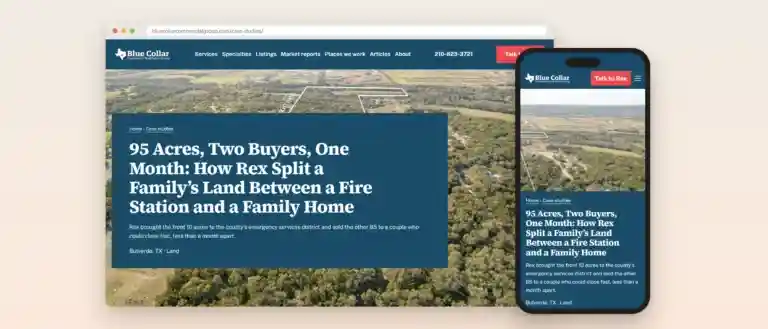
A case study describes real work. A market note explains a dated observation. A plain answer addresses a question a client might reasonably bring.
The format should follow the job. A long article is not automatically more useful than a clear page answering a focused question.
The reader asks: Have you handled work like this?
Use a case study, an account of a real challenge, your approach and the result.
Say you helped a tenant compare warehouse options outside Denver. In an actual, permitted account, describe the operational requirement, what you checked and your role in the decision process. The useful part is the reasoning, not merely the signed lease.
Another reader can examine the contribution. An owner can see what affected tenant fit. A business can see how space and operations connected.
Keep the result historical. It does not prescribe the ending for the next assignment.
Use only real work with confirmed facts and appropriate permission. A hypothetical example can teach a point when clearly labeled, but it is not your track record.
The form belongs when the reader needs evidence of experience. A career adjective cannot do that job.
The reader asks: What should I pay attention to locally?
Use a market note, a dated explanation of an observation and its relevance.
You do not need to announce a trend whenever you notice a practical issue. Suppose, as an example, an access question comes up while examining commercial property outside Tulsa. Explain the question and why it deserves checking.
Do not turn that example into a statement that every property in the market has the problem. Do not turn an old observation into a present-tense market claim.
A note can identify useful questions without offering a forecast. Who should confirm the issue? What information should an owner gather? What would change the interpretation?
The town should matter to the explanation. Adding a town name to a generic article does not make the article local.
If you do have a current observation from your own work, confirm it, date it and define the limit. The reader should understand what you saw and what you have not established.
A plain note is a better use of knowledge than a report voice pretending the whole market fits inside it.
The reader asks: What do I need before talking with you?
Use a plain answer to a recurring client question.
Explain what an owner should gather before a discussion. Explain how a business should describe its space requirements. Explain the information you would want before considering an acquisition.
Choose questions you actually hear. The public answer should clarify preparation, not decide a particular client’s course of action without the facts.
Say the question is about a warehouse search. Discuss loading, staff access, storage and timing where they belong. Explain why those requirements help compare options.
Keep the words close to the meeting. If a paragraph needs a dictionary, the reader is doing work you should have done while editing.
A useful answer can be short. Put the main point on the page and connect it to the relevant service. Let the broader site show the rest of your practice.
The reader gets a way to prepare. You get an account you can send when that question arises.
The facts have to survive the writing tool
In a February 2026 RPR survey of 225 agents, 92% said they use AI or plan to. That’s why the internet is filling up with the same bland CRE articles. Use the tools. Just don’t let them lower your bar.
Supply source material: the facts and permitted records used to prepare the writing. Keep uncertainty visible. Do not let the tool invent a local observation or turn a hypothetical example into completed work.
Review the role, timing and result. Check that an opinion is supported by the example or reasoning on the page.
Then read the draft aloud. Cut the grand words that hide a simple point.
You can use AI to arrange your knowledge. You cannot use a busy publishing schedule as permission to manufacture it.
The finished page should answer something a prospect checking you would reasonably want to know. If it doesn’t, a smoother paragraph is not the repair.
Use the account where its question belongs
A useful page should be something you can share for a reason.
Send a case study when it explains relevant experience. Send a preparation answer when it helps someone get ready for a meeting. Share a market note when the observation belongs in the conversation.
Explain the connection briefly. Don’t make the reader search through unrelated material to find why you sent it.
AI tools may also find the page. Readable writing gives them material to use, without determining whether they include you or describe the account correctly.
Look for evidence of clarity rather than applause.
Ask an outside reader what the page explains. Ask which question it leaves unanswered. Listen when a prospect refers to something they read.
Those observations can guide revisions. They do not establish that the writing caused a deal or that a popular post represents better professional work.
A page that answers the wrong question may need a different topic rather than stronger language. A page that confuses the role may need factual clarification.
Choose and finish a useful page this week
Choose a piece of writing you can finish from information you already have.
- List questions from actual work. Keep private circumstances out. Note what a prospective client would need to understand.
-
Assign the right job. Decide whether the missing explanation concerns experience, an observation, a general question or a service.
-
Gather the supporting material. Confirm facts and permissions before drafting. Mark uncertainty instead of filling it with a plausible detail.
-
Write the plain answer first. State the main point, then explain the context and what it means for the reader.
-
Review for accuracy and ordinary speech. Read aloud. Remove unsupported claims and phrases you would not use in a client meeting.
- Use the account where it helps. Put it in the record and share it in a relevant conversation. Notice whether the reader understands the intended point.
Keep a list of unfinished questions rather than a large publishing schedule. That lets the work supply topics while leaving room for active assignments and client needs.
Before publishing a market note, ask whether a reader could mistake your observation for advice about their particular property. If so, explain the limit in the note.
If a page already answers the question well, update it where necessary instead of writing another version. The record should become more useful, not simply longer.
Delete the page with no job
Before starting another article, write the question it will answer.
If the question is whether you have handled a situation, choose evidence from real work. If it concerns a dated local observation, choose a market note. If it concerns preparation, choose a plain answer.
A service page carries a steadier job: explaining whom you help and what the work involves. Do not bury the basic service account in a blog entry nobody knows to search for.
Then identify a real use. Would you send this page after an owner call? Could a referral source pass it to a tenant? Would it help a buyer prepare a useful question?
That is an editorial test, not a prediction about business results.
A generic article can be accurate and still fail to explain your practice. Accuracy is necessary. Relevance and evidence are the reasons the page belongs in your record.
If an existing page already answers the question, improve it rather than publish another version. Keep the record usable.
The point is not a contest to produce the most text. It is to stop useful knowledge from staying in the meeting while the website fills with generalities.
Where UpliftCRE fits
I built UpliftCRE after our team at Blue Collar Commercial Group faced the gap between useful working knowledge and unfinished public writing.
UpliftCRE pairs a commercial real estate website built so prospects and AI can read it with an AI marketing staff that writes with you in ten-minute meetings. Bring the assignment, local observation or recurring question. You review each page you create before it publishes. On the Growth and Authority plans, Market Voice also publishes articles about your local market for you each week.
The staff helps choose a clear account and organize the facts. The site gives the writing somewhere to live and somewhere to point in a conversation. Your knowledge supplies the reason for the page; a calendar does not.
Frequently asked questions
Do I need to publish a long article?
Choose the format that serves the question. A focused answer may be enough.
What is the difference between a case study and a market note?
A case study explains an assignment. A market note explains a dated observation and its possible relevance.
Can I use questions from client meetings?
Use the general question where appropriate. Keep private circumstances and restricted information out.
Should each page describe my entire practice?
Let each page do a focused job. Connect it to a broader introduction so the range remains clear.
How do I know the writing is useful?
Ask what the reader understood and use the page in relevant conversations. Keep those observations separate from claims about business results.
Glossary terms used in this article
- Content: The writing and other material you share.
- Case study: An account of a challenge, approach and result.
- Market note: A dated explanation of an observation and its relevance.
- Service page: A page explaining whom you help and what the work involves.
- Source material: The facts and permitted records used to prepare writing.
Sources: RPR, February 2026.