TL;DR
- Lead generation is a system you run every morning, not a campaign you launch. The one I teach in my book comes down to seven parts, and none of them requires a marketing department.
- Pick your ground before your property type. A named area you can drive, learn and become known in. Owners don’t sort their lives by our property types.
- Build your Thousand and work it with 10×10×10. About a thousand buildings in your ground, and every weekday morning ten letters, ten emails and ten calls, as one sequence spread over three weeks.
- Every letter is a give. The owner’s property at the top, then what’s happening in their market and what it means. Then they look you up, so your website has to back up the letter.
- Qualify hard and count what’s real. Three questions tell you whether a lead has a real need and a reason to act. Four more confirm whether they can, and will, sign. Count conversations and signed work, not activity.
The short answer
Commercial real estate lead generation works best as a system you run every morning, not a campaign you launch and hope for. The system I teach in my book, The Look-Me-Up Moment, comes down to seven parts:
- Pick your ground. A named set of corridors, neighborhoods and submarkets you can draw on a map and drive every week.
- Build your Thousand. A working list of about a thousand commercial buildings in that ground: addresses, owners, what’s in them and what’s changed.
- Run 10×10×10. Ten letters, ten emails and ten calls every weekday morning, before deal work eats the day.
- Make every letter a give. Something useful about the owner’s property and market, not a “Thinking of selling?” postcard.
- Survive the look-up. Every owner who gets your letter can look you up. Your website has to agree with the person who wrote to them.
- Qualify with three questions, then four. What do you need, by when, and what does it cost you to wait? Then: who signs, what forces a decision, is the number real, and am I alone?
- Count the right things. Conversations separate from activity, signed work separate from hope, and the conversations that came to you without you starting them.
It’s slow at first. Commercial real estate is slow, until the day it suddenly isn’t. The rest of this guide walks through each part the way I’d explain it to an agent sitting across the table from me.
Suspect, lead, prospect, client: four words worth getting right
I hear “lead” used for any name on a list all the time in commercial real estate. I think that’s one of the most common mistakes in the business, and it costs agents a lot of wasted effort. Four words, kept apart, make the whole system clearer.
- A suspect is a name with a possible need: an owner on a list, a building you think might sell, a business that may outgrow its space. They haven’t shown any interest yet. Your Thousand is a list of suspects.
- A lead is someone who has shown initial interest or started a one-way interaction: they called after your letter, replied to your email, filled out a form on your site or asked for the full market report. They’ve raised a hand, but you don’t yet know whether there’s a deal.
- A prospect is a qualified lead. You’ve confirmed they have the desire, the need and the ability to do a deal.
- A client has signed: a listing agreement, a tenant or buyer representation agreement, or a paid broker opinion of value.
The system below moves people up that ladder. Most of your mornings are spent with suspects. Most of your judgment is spent deciding who has really become a prospect.
1. Pick your ground, not your property type
You’ll hear “pick a niche” a lot. I’d start with a place.
In the book, I call it your ground: a named set of corridors, neighborhoods and submarkets with edges you can draw on a map. Big enough to support your business. Small enough that you can keep learning it. “The entire metro” is where you’ll take work, but it isn’t a place you can know in detail.
Ground beats property type because an owner doesn’t sort his life by our categories. He might own a strip center, two flex buildings and a piece of land near an interchange. If you walk in as “the retail guy,” you can help with one of those properties, and you might miss the bigger decision he’s trying to make. An agent who knows the ground can see how his decisions connect: which property a road change affects, when the leases end, who else owns around that interchange, whether selling one would help him improve another.
Work in one place compounds. Help a business buy a building, and you meet its lender, the seller, the owner next door and the contractor who knows which businesses are expanding. Help a landlord with a vacancy on the same streets, and you learn why the tenant left and what the next one needs. Every deal leaves you with more than a fee: more owners you know, more buildings you understand, and a reputation people can say in one sentence with a place attached.
This isn’t a wall around your judgment. If an owner in your ground needs help outside your skill, bring in the right person or refer the work for a fee. Either way, you give yourself the best shot at staying the advisor he calls first. It’s the same breadth idea we cover in how to get found for more kinds of deals: know the ground and the owners, not just one slice of their world.
Our ground at Blue Collar Commercial Group, the team I run with my dad, Rex, is the growing stretch that connects North San Antonio to South Austin: northern Bexar, Comal, Guadalupe and Hays Counties. We can name it, we can drive it, and it’s growing fast enough to support the business.
Picking yours. Already closed some deals? Put them on a map. Where do they cluster? Where do people already call you? That may be the start of your ground. Starting fresh? Pick an area you can actually drive and keep revisiting.
2. Build your Thousand
Now build a list of about a thousand commercial buildings inside your ground.
Not a thousand names a vendor sold you as “leads.” Buildings. Addresses. Owners of record. Who’s in them, where you can verify it. What type they are. What sold, and when. What changed. What you still don’t know.
In the book, my starting filter is improved commercial property with at least a million dollars in tax value. Land goes on a separate list, because those owners and those conversations are different. I leave some things off the working list: government property, big institutions with no real person you can reach, and buildings another agent has under an exclusive listing right now. You can still watch those. You just don’t pitch them today.
Two notes on that filter. Tax value isn’t market value. And a thousand isn’t a magic number. It’s big enough to support a real practice and small enough to force you to choose where you’ll spend your time.
If you’re picturing a giant software project, stop. Start with a spreadsheet: address, owner of record, property type, tax value, last sale, any contact information you can trust, and a notes column for what you saw or learned. Don’t know the lease expiration or who’s behind the LLC? Leave it blank and go find out. A blank cell beats a confident guess.
The list gets better as you work it. Building it teaches you the ground. Keeping it current keeps you close to the decisions being made there. And you never publish your Thousand. It stays in your private system. What you publish is the judgment it gives you.
3. Run 10×10×10
Ten letters. Ten emails. Ten calls. Every weekday morning, before deal work eats the day.
That’s three steps of one sequence spread over time, not thirty new owners a day. This morning, you mail ten letters. Next week, those ten owners get a short email. The week after that, you call them. And every morning, you’re mailing the next ten. So once it’s running, a normal morning is ten new letters, ten emails to last week’s letter group and ten calls to the group from two weeks ago. The first two weeks are a ramp. Don’t invent emails and calls on day one just to hit a number.
Ten letters a day is fifty owners a week. Some owners hold several buildings, so a thousand buildings is fewer than a thousand owners, and at that pace you get through the whole list and come back around with fresh information. It’s a cycle, not a one-time blast.
A few rules make it work:
- Sort by what you do best. In the book, I sort by property type, then by value within each type, starting with the deals you handle best. Rex starts with industrial. That doesn’t make him an industrial agent. It just means the daily work starts where his conversations are strongest, while the ground stays at the center.
- One owner, one letter. When one owner holds several buildings, send one letter that names the properties correctly. Five copies to five LLC addresses aren’t five relationships.
- Ten, because ten survives. Ten survives a closing week, a sick kid and a morning when a deal is trying to blow up. Thirty a day looks great in a coaching workbook. A number you quit after nine days is worth nothing.
- Protect one hour. The book’s standard is one hour before deal work. Prep the property data and the market report ahead of time, and save that hour for the parts only you can do: choose what matters, sign the letters, send the follow-ups, make the calls and write down what you learned.
4. Make every letter a give
The letter isn’t a glossy postcard with your face on it and “Thinking of selling?” in huge type.
Put the owner’s property at the top, so it’s obvious you know which building you’re writing about. Then give them something. In the book, the standard is five highlights from a market report, and more important, what those highlights mean. Numbers without your read are just another PDF in the trash.
No market report yet? Start with five things you noticed on a recent drive, and what they might mean. Don’t invent a trend from one empty storefront. Tell the owner what you saw and what question it raises.
Hand-address it. Sign it. Yes, it’s old-fashioned. The owner already gets plenty of mass-produced marketing. You’re trying to start a conversation with one person about a building you’ve actually looked at. Then give them a way to read the full market report, or learn more about you, on your own website.
Don’t tell an owner you’ve seen their property when you’ve only looked at Google Street View. Street View photos can be years old. An agent I worked with told an owner he’d driven by the building last week. The owner said, “Funny. It was torn down two years ago.” Then the line went dead. If you haven’t been there, say what you actually looked at: “I pulled up the county record and the street view.” Better yet, drive it before you write the letter. And check the capture date that Street View shows on every image.
The email, a week later, can be four sentences. Did the letter arrive? Was anything useful? If you’re working through a property decision, I’m here. Here’s the link again. No fake urgency, and no “just bumping this to the top of your inbox.”
The call, a week after that, is a follow-up from a name the owner may now recognize. Some will go to voicemail. Fine. You’re calling about their property and the information you sent, not pretending to be old friends. If they answer, stop reading a script. Ask what they’re working through, and listen.
Some owners will say they aren’t interested. Respect it. Some will ask you to stop. Honor it, and mark it on your list. And some will ask a question you didn’t expect. That’s the opening you did all this work to earn.
A note on the rules. Calls, texts and email come with rules: the National Do Not Call Registry and state calling rules, consent rules for texting, and the CAN-SPAM Act for commercial email (a working way to opt out, a truthful subject line and your physical address). They apply in different ways, and business lines and cell phones aren’t always treated the same. Your brokerage may have its own policy on top. Check both before you start, and ask your brokerage when you’re not sure.
5. Survive the look-up
When an owner gets a letter from an agent they’ve never met, they’ll often look you up. They search your name, open your website, maybe ask ChatGPT or Google’s AI who you are. In those few minutes, they decide whether you’re worth a reply.
If they find a generic name on a generic site, your letter did half its job and then hit a wall. If they find a site that agrees with the person who wrote to them, with your deals, your market reports and a clear picture of your ground, the call back gets a lot easier.
That’s why the system feeds your public record as you run it. The market report you quote in the letter lives on your site. A question you keep answering for owners becomes a page. A closed deal, with permission, becomes a case study. Every pass through the Thousand gives you something new to publish, and every page you publish makes the next letter land better.
Your site has three audiences now: the owners who read it, the search engines that index it and the AI chatbots that answer questions about you. We walk through what it needs for all three in What Should a Commercial Real Estate Agent’s Website Include?, and through the look-up itself in The Look-Me-Up Moment.
Why it works, even when nobody answers
This is where I see agents quit. They run the system for a month and say, “Nothing happened.”
What did they expect? An owner who bought a building fifteen years ago doesn’t decide to sell because your letter arrived on Tuesday. In my experience, most weeks the calls won’t turn into meetings. That’s normal. You can’t schedule an owner’s decision. You can make sure that when it starts to form, they already know who you are and what you know.
There’s a second payoff that doesn’t show up in your response count: every pass through the Thousand teaches you more. You fix ownership records. You notice a lease sign. You learn the owner of one building owns three others. You hear a business is expanding. You find out which market observation people cared about and which one nobody did. That makes the next letter better, and the next conversation.
Two made-up advisors show the difference. Neither is a real person.
The first works in Fort Worth. She draws her ground: a few connected submarkets she can drive every week. She builds her list. One owner has a small retail center and two flex buildings, and there’s talk of an access change near one of them. Nothing’s approved. She checks the public record, then writes to him about what’s known and what’s still uncertain. That’s a much better letter than “the market is hot.” He may not answer. He may file it away. Six months later, he may call because a tenant is leaving. Or he may never call. Her job is to have a real reason to reach out, and to understand the ground when he does.
The second advisor buys a list of a thousand names with bad ownership data and sends the same “Want to sell?” email to all of them. His software says a thousand sent. How many real owners did he reach? How many will remember him in a month? He doesn’t know.
Activity is easy to count. Relationships and real knowledge take more work. I’d rather have a working Thousand than a much bigger pile of names I can’t explain.
6. When an owner answers: three questions
A list isn’t a pipeline. An owner who says “Good report. I’ve got a question about the empty building on my block” has opened a conversation. Now they’re a lead, and your job is to find out whether they’re a prospect.
In the book, the whole framework comes down to three questions:
- What do you need?
- By when?
- What does it cost you to wait?
Don’t recite them like an intake form. Use your own voice and follow the conversation. If the owner tells you the deadline first, don’t interrupt to ask question one. The questions are a way to think, not a checklist.
- “What do you need?” isn’t “What kind of property do you own?” You already know that. It’s an invitation to tell you what’s actually going on. “I want to sell” might mean she’s retiring, a partner is leaving, the building eats more time than it earns, or she’s just curious what it’s worth. Those are four different conversations.
- “By when?” tells you about timing, and often about what’s forcing the decision. If it’s two years out, they belong in your long-term follow-up, not your weekly calls.
- “What does it cost you to wait?” tests desire. If waiting costs them real money or real trouble, they have a reason to act. If it costs nothing, there may be no urgency yet, and that’s worth knowing too.
Being direct isn’t pressure. You can ask, “Is this a decision you’re working toward, or are you gathering information for later?” That gives them room to tell you the truth. And you can say, “I don’t think you need to sell yet,” if that’s your read. The advisor who can say that is worth far more than the one who turns every reply into a pitch.
When the answer is “not now,” push once to make sure you understand: “Is there a date, or a change, that would make this worth revisiting?” A lease renewal. A loan. A family decision. If there is, write it down and follow up when it matters.
7. A conversation isn’t a client: four questions
Someone can like you, ask your advice and call you “their agent.” If they haven’t signed an agreement, they haven’t hired you.
That doesn’t make them dishonest. They may still be working out what they want. And some owners know exactly what they’re doing: they ask three advisors for detailed proposals, collect the best ideas and decide later whether to sign with anyone. You don’t have to be angry about that. You do have to know when that’s the room you’re in.
So before you spend days on a proposal, put your three most active opportunities on a page and write four answers under each:
- Who signs? The person asking may not be the one who can hire you: a property manager, one partner in a group, an owner’s son gathering options for a family that hasn’t agreed to sell. Ask who else is part of the decision and whether they should be in the meeting. “They’ll decide” isn’t an answer.
- What forces a decision? A lease ending, a loan coming due, a partner who wants out, money needed for another purchase. It doesn’t have to be a crisis, but the date should belong to the owner, not to your forecast. If there’s no answer, set a dated follow-up and stop acting like a signature is around the corner.
- Is the number real? Every owner has a number. Can a buyer in this market pay it? Show the owner how you got to a price, and don’t take an impossible price just to put a sign in the ground. If the market won’t support it, say so: “I don’t think the market will pay that. Here’s why.”
- Am I alone? Interviewing several advisors is normal for a decision this big. Ask who else they’re talking to and how they’ll decide. Then ask yourself the uncomfortable one: what can I bring that the others can’t? A polished deck is the minimum now. Your difference has to be your judgment, your knowledge of the ground, your access to real buyers and your record.
These four finish the job of qualifying. “Who signs?” and “Is the number real?” are the ability half of a prospect: someone who wants to act but can’t sign, or can’t accept a price the market will pay, isn’t a prospect yet.
When a pursuit passes the filter, prepare. At Blue Collar, the listing presentation is free, because we want the owner to see our thinking before he hires us. We deliver it in a conversation, at the property if we can, in this order: the facts of the property, who would buy it and why, how we’d reach them, the price near the end (so it follows from the work he just watched), what we might have missed, and then the agreement itself, while the reasoning is still fresh.
And know where free stops. A real first conversation, a walk of the property and a credible plan are part of earning the job. A full marketing campaign isn’t, until you’re hired. At Blue Collar, Rex wants an exclusive agreement before we market a property, so both sides are committed to the work. Know your own terms, and your firm’s, before you walk in.
I’d rather have a straight “not this quarter” than a false “any day now.” The maybe eats your meetings, your analysis and your energy, and promises you nothing back.
8. Count the right things
10×10×10 gives you plenty to count: letters, emails, calls. Those are activity counts. They tell you whether you kept the habit. They don’t tell you whether the system is working.
Count conversations separately. A voicemail is a touch, not a conversation. An owner who picks up and says “no thanks” gave you an answer, not a conversation. A conversation is when you actually learn what they need and what would make them act. For every real conversation, write down five things:
| Date | Where it came from | What they need | Timing | Next step |
|---|---|---|---|---|
| Letters, referral, sign, website, someone who looked you up |
Count what came to you. Once a month, count how many of those conversations came to you without you starting them. I care about that number. It tells you whether your reputation and your public record are starting to work alongside your outreach. In the beginning, it might be zero. Fine. Write it down and watch whether it moves. Treat it as a gauge on the system you’re building, not a grade on you.
Count signed work for what it is. Once a month, list your active work in two columns: signed and speculative. A warm owner with no agreement goes in speculative, no matter how much you like them. If the speculative column keeps growing, run the four questions again. Some of those can be fixed by bringing in the decision-maker, agreeing on how you’ll set the price or setting a decision date. The rest go back to your relationship list, get referred or get released, on purpose.
You’ll notice there are no conversion rates in this guide. Your market, property types and relationships are your own, and so are your numbers.
Set a goal from your own math
The system needs a goal, and it should be yours, not one borrowed from a coaching slide. Run your own math: your typical deal size, your fee, what’s left after your split and your expenses, and what you want next year to look like. Then work backward to how many signed assignments that takes, and whether your ground can support it.
A goal isn’t a forecast. Deals don’t show up because you made a spreadsheet. But if you chase a real goal and fall short, you can still come out ahead: you’ll likely know your ground better than most, more owners will know your name, and you’ll be further along than if you’d never set a number at all. The discipline is putting your assumptions on paper instead of hiding them under “I want to grow this year.”
Then use the goal as a filter. When an assignment shows up, ask three questions: Is it real? Can I do it well? Do I have time? A deal outside your ground can still be worth taking. A deal inside your ground can still be a bad listing. What I don’t want is a practice run by panic, where a thin pipeline pushes you into work you can’t do well, at a price the market won’t pay, for an owner who won’t decide.
The fair objections
“This is slow.” Yes. The question is whether your quiet months leave you better positioned when an owner is ready.
“I have listings to service. I can’t spend all morning on letters.” Then protect a smaller block you’ll actually keep. One hour, before deal work, with the prep done ahead of time. Ramp up to ten if you need to. Then make the number real.
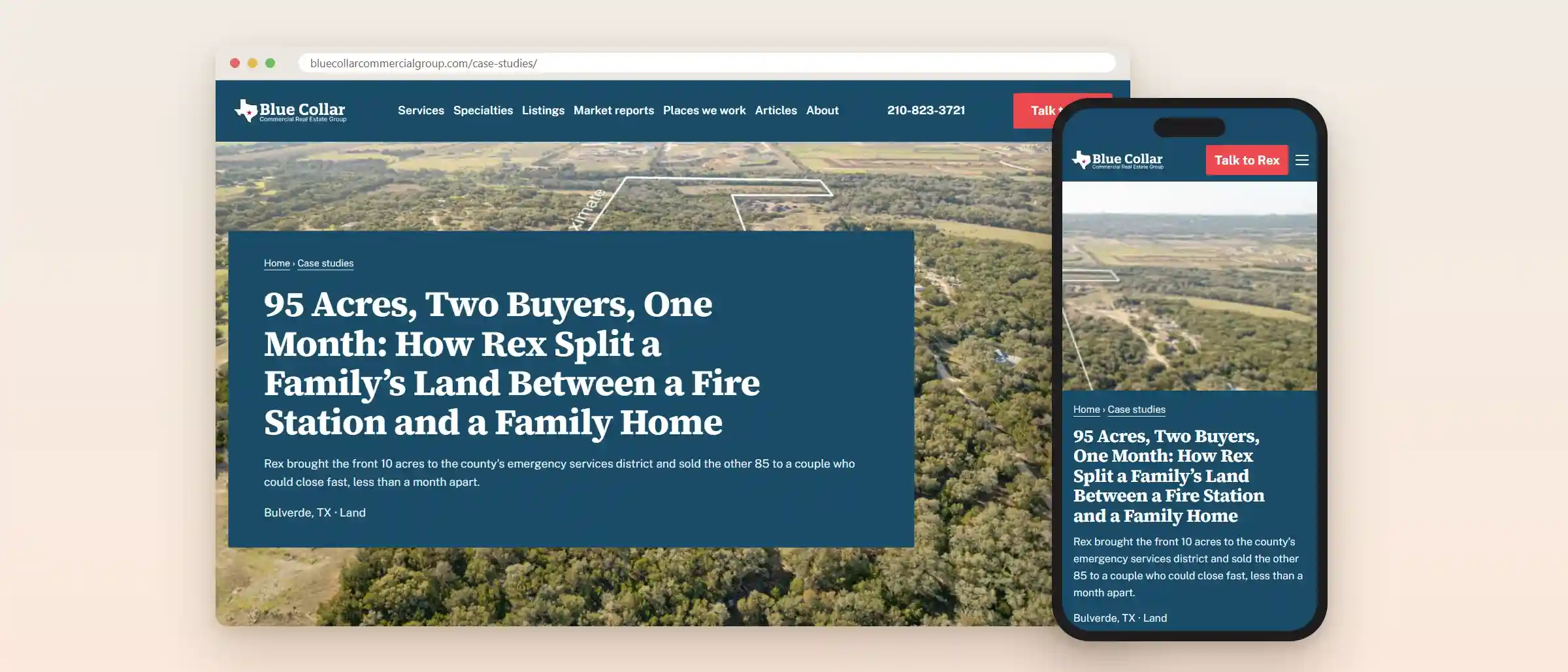
“I already get business from referrals.” Good. Keep those relationships. The Thousand doesn’t replace them. It helps you become known to owners who’ve never met you, and it gives you a better map of the ground your referral partners ask you about. One real example from Blue Collar: the team had already sold a 10-acre tract to the Comal County Emergency Services District and knew the district needed more sites. When a family decided to sell 95 acres nearby, Rex brought the district the front 10 acres, and a couple bought the other 85, less than a month apart (95 Acres, Two Buyers, One Month). That match came from knowing the ground and the people in it.
“Can’t I just buy a list?” You can buy names. You can’t buy knowledge of your ground. A bought list is a list of suspects with ownership data you still have to check, and it doesn’t teach you anything until you work it.
What AI changes, and what it doesn’t
AI is changing commercial real estate lead generation in real ways. I’d also be careful with a lot of what’s being promised.
It changes how owners find and check you. People can now ask ChatGPT, Gemini, Perplexity or Google’s AI to recommend a commercial agent, and those tools answer from what they can find. It isn’t settled yet: when UpliftCRE asked four AI tools to name the top commercial brokers across 79 metro areas and three property types, over and over, only 2.5% of the repeated asks returned the same list. No one owns those answers yet. The agents who give these tools a clear, specific, checkable record of their work give themselves a real shot. We’ve seen it at Blue Collar. After ChatGPT came out, people started finding the team through AI answers, and other KW agents asked Rex how. His answer was two words: “the website.” It can pay off for clients too. Elgin Wells, a KW Commercial advisor in Houston and an UpliftCRE client, put it this way: “When I answered the phone and the prospect told me ChatGPT said to call me, I thought Jason was punking me.” That’s one advisor’s experience, not a promise. To see where you stand, test what AI says about you.
It makes the spreadsheet worth less. Property data is easier to get than ever. Tools pull comps, and AI can organize records and draft a first pass at an explanation. So being the person with the spreadsheet is worth less every year. What’s worth more is knowing what the data means on the owner’s street.
It helps you prepare and write, if you check it. AI can summarize public records, draft questions before a call and turn your notes into a market report or case study. It can also get facts wrong, mix up owners and fill gaps with confident guesses. You supply the facts, the AI drafts, and you read every word you create before it goes out with your name on it.
It doesn’t make you an expert in every property type. A tool can raise a question about a data center’s power needs. It can’t make you qualified to represent that seller. Use the tools to see more of your ground, faster. Use your judgment to decide what matters.
Be skeptical of tools that claim to predict who’s about to sell (ask for proof in your market before you pay), lists of “motivated sellers” (motivation is something you find out by talking to people), automation that sends messages for months without anyone reading them, and anyone who promises AI will recommend you. Nobody controls what AI tools say.
Where UpliftCRE fits
The system needs a public record that agrees with your letters, and that’s what UpliftCRE builds: a commercial real estate website with pages for your bio, your markets, the property types and services you handle, your market reports, your closed deals and your case studies, plus a native page for each listing with a message form. It’s built for all three audiences: owners, search engines and AI chatbots.
The work that feeds your letters lives there too. In a ten-minute meeting, you answer a few questions, and the AI staff drafts the market report, the case study or the listing page. You publish it when it’s right. On the Growth and Authority plans, Market Voice articles about your local market publish for you once or twice a week, without a review step, after automatic checks, and you can unpublish any of them at any time.
When an owner reaches out, the message lands in a leads inbox on your site, where you can track it from new to closed or lost and keep a log of what happened. Leads can also be passed on to other tools, such as your CRM, through services like Zapier or Make.
$249 setup (non-refundable), then $149 to $229 a month. Your first month is free on monthly plans. Our target is a site preview in three to five business days.
Frequently asked questions
What is the best lead generation system for a commercial real estate agent?
A system you can run every morning beats any single tactic. The one in The Look-Me-Up Moment comes down to seven parts: pick your ground, build a list of about a thousand buildings in it, run 10×10×10 (ten letters, ten emails, ten calls each weekday), make every letter useful, make sure your website backs you up, qualify with three questions and then four, and count conversations and signed work separately.
What’s the difference between a suspect, a lead and a prospect?
A suspect is a name with a possible need. A lead is someone who has shown initial interest or started a one-way interaction, such as calling after your letter or asking for your market report. A prospect is a qualified lead with a confirmed desire, need and ability to do a deal.
What is 10×10×10 in commercial real estate prospecting?
It’s ten letters, ten emails and ten calls every weekday morning, run as one sequence over three weeks. Each group of ten owners gets a letter one week, a short email the next and a call the week after, while you mail the next ten every morning.
How do I qualify a commercial real estate lead?
Start with three questions: What do you need? By when? What does it cost you to wait? If the answers show a real need, a real timeline and a real cost to waiting, check four more before you invest days in a proposal: Who signs? What forces a decision? Is the number real? Am I alone?
Should I buy lists of property owners?
You can buy names, but not knowledge of your ground. A bought list is a list of suspects with ownership data you still have to check. A working list you build yourself teaches you the ground as you build it.
Can AI generate commercial real estate leads for me?
AI can help you research, draft and publish faster, and AI chatbots can put your name in front of people who ask for an agent. It can’t replace your knowledge of the ground, your judgment or the relationship, and nobody can guarantee an AI tool will recommend you.
Glossary terms used in this article
- Suspect: A name with a possible need who hasn’t shown any interest yet.
- Lead: Someone who has shown initial interest or started a one-way interaction, such as calling after your letter.
- Prospect: A qualified lead with a confirmed desire, need and ability to do a deal.
- Client: Someone who has signed an agreement with you.
- Ground: A named set of corridors, neighborhoods and submarkets you can draw on a map and drive every week.
- The Thousand: A working list of about a thousand commercial buildings in your ground.
- 10×10×10: Ten letters, ten emails and ten calls every weekday morning, run as one sequence over three weeks.
- Market report: A dated write-up about what’s happening in a local market, and what it means for owners.
- Look-up: The moment an owner searches for you online after you reach out, before deciding whether to respond.
- Signed vs. speculative: Active work with an agreement, versus warm opportunities without one.
- Broker opinion of value (BOV): An agent’s written estimate of what a property would sell or lease for.
- Exclusive listing: An agreement giving one agent the right to market a property for a set time.
Sources: Jason Blackburn, The Look-Me-Up Moment (the ground, the Thousand, 10×10×10, the three questions and the four questions). UpliftCRE, About UpliftCRE (AI recommendation study and client quote). Blue Collar Commercial Group case study: 95 Acres, Two Buyers, One Month.