TL;DR
- If cold calling feels like a waste of your time, you’re not lazy. The numbers say dialing strangers with nothing to offer is a hard way to start conversations.
- I quit cold calling in 1995, the same year I started. I mailed first and called second, and I’ve run that system for 30 years.
- The loudest voices for cold calling often sell something that depends on it: coaching, a dialer, phone lists or a course.
- Their own numbers are rough. By my math from Gong’s broader B2B dataset, an average rep needs about 400 dials to book one meeting.
- In a CRE coaching firm’s 2018 comparison (an illustration with different callers and audiences, not a controlled study), campaign-backed calls produced about four times as many meetings per dial as cold calls, by my math from its numbers.
- Stop making the phone the first touch. Send something useful, follow up by email to say you’ll call next week, then call. The owner is still a stranger, but you’re no longer coming out of nowhere.
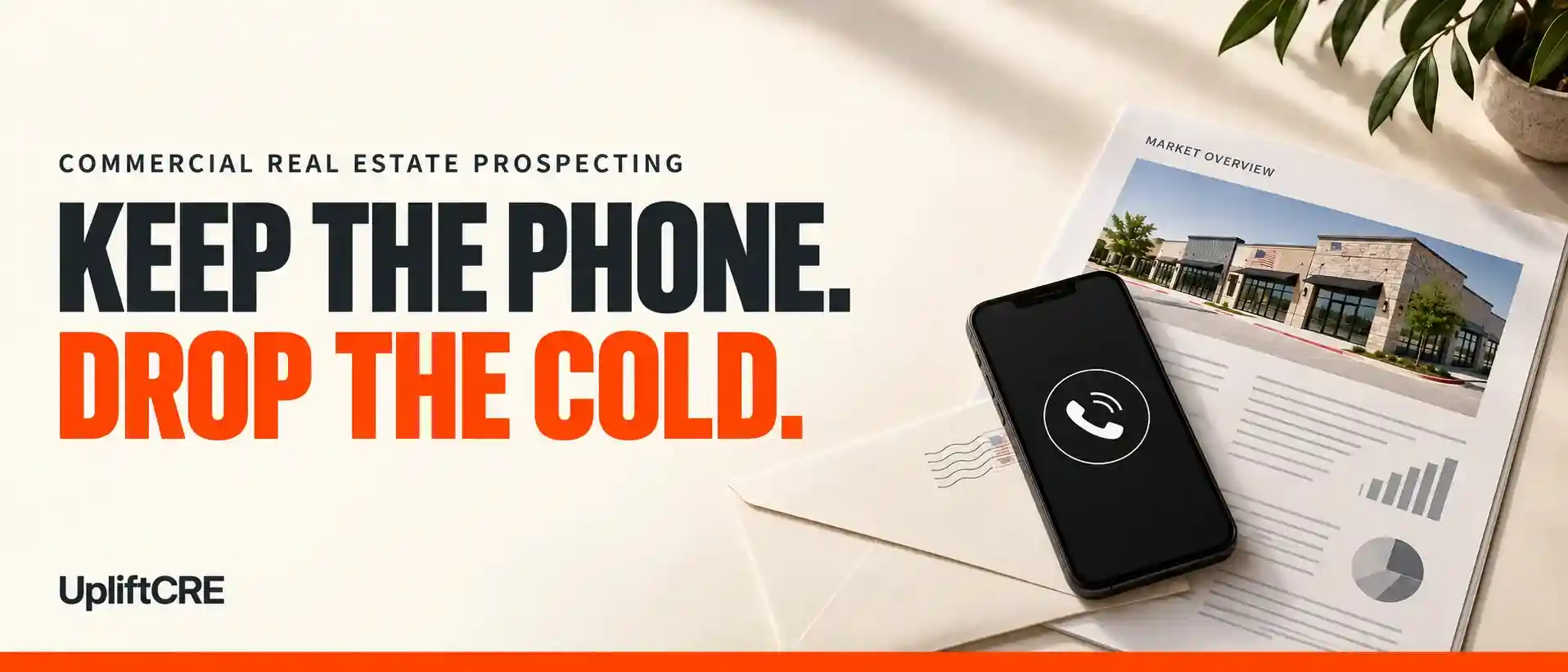
- Keep the phone. Drop the cold.
The short answer
For most commercial real estate agents, dialing strangers with nothing to offer is a poor use of the hours you have. Most strangers don’t answer, most who answer don’t book a meeting, and some of those calls cost you goodwill with owners in your market. A lot of agents already feel this. They keep dialing because they’ve been told the problem is their effort, and because nobody has handed them something better.
There is something better: stop making the phone the first touch. Send each owner something useful about their own property, follow up with an email that says you’ll call next week, and then call. That’s the system I’ve run since 1995 and teach in my book, The Look-Me-Up Moment. The phone stays. The cold goes.
Cold calls, warm calls and lead calls
Three kinds of calls get lumped together as “prospecting.” They aren’t the same.
- A cold call is an unexpected first contact by phone. The owner has had no contact from you and no reason to expect the call.
- A warm call comes after outreach you did on purpose, outreach that tells the owner who you are, why you’re calling and when. Mail an owner a letter, follow it with an email that says “I’ll call you next week to follow up,” and then call. That’s a warm call. An introduction from someone they trust, or a conversation you’ve already had, works the same way.
- A lead call follows a real signal of interest. The owner replied, called, filled out a form or asked for something. They raised their hand.
A warm call doesn’t need the owner to have answered you. They may not have read the letter. They may not want to talk. But you’re no longer appearing out of nowhere, and you have a specific, checkable reason to call.
That’s the whole shift I’m asking for: stop making the phone the first touch. The old routine is find an owner, dial the owner, interrupt the owner. The warm routine is research the owner, send something useful, tell them you’ll call, then call. The owner is still a stranger. You’ve just earned enough context to make the call less of an intrusion.
Knowing something about the owner doesn’t make the call warm on its own. A database can tell you their loan comes due next year. If the phone is still your first touch, it’s still a cold call. Send them something useful about it first, tell them you’ll call, and it becomes a warm one.
You already know
You’ve sat with the list. A spreadsheet of owners you’ve never met, a phone, and a number you’re supposed to hit before lunch. You dial. Voicemail. Voicemail. Disconnected. Someone picks up, hears “commercial real estate,” and hangs up. Someone else is polite about it, which is somehow worse.
At the end of the morning you’ve done the work, and you have nothing to show for it except a tally. And the voice in your head says the same thing the trainers say: you didn’t make enough calls.
That voice didn’t come from nowhere. CRE training has long treated call volume as the measure of effort. An entry-level agent posting from Marcus & Millichap describes the job as “new business development via client outreach including cold calls (60+ calls per day).” In 2017, the Massimo Group, a CRE coaching firm, called 100 calls a week “the bare minimum I would suggest for most commercial real estate professionals.” In December 2025, it still called the prospect call brokers’ primary source of commission income.
When the method is the volume, the only way to fail is to not do enough of it. So when it doesn’t work, the failure lands on you. You weren’t disciplined enough, tough enough or hungry enough. The advice rarely asks whether the method is the problem.
I quit cold calling in 1995
I know that list because I was handed one. In 1995, my boss gave me a criss-cross directory, a book that lists addresses and phone numbers street by street, and told me to dial for dollars.
I hated it. I started cold calling in 1995, and I stopped cold calling in 1995.
Instead, every morning I mailed the people in that directory a company brochure with my business card. The next week, each of them got a letter built on three elements: personalization, obligation and urgency. The week after that, I called.
They were still suspects, and most of them had never heard of me. But by the time the phone rang, my name had reached them twice, and I had a reason to call.
My boss didn’t know any of that when he handed me the #1 sales producer plaque, month after month. It was my secret for beating salespeople with more years and more experience than I had.
I’ve run that same system for 30 years. 10×10×10 is the version I teach today.
Follow the money
Before you take advice on how to prospect, ask what the person giving it sells. A surprising amount of the loudest cold-calling advice comes from people whose business depends on you dialing.
Start with coaching and software. The Massimo Group, the same firm quoted above, sells coaching programs and a platform called CRE Launcher, “Automated Prospecting & Follow-Up for CRE Brokers.” As of October 2026, its plans run $499 and $999 a month. Both bundle owner data for building call and outreach lists, email and text campaigns, call tracking and a dialer, and AI voice and text agents. The pricing page opens with the math it wants you to do: “The average CRE transaction generates a commission between $25,000 and $150,000,” so one extra deal a year pays for it. To be fair to Massimo, the bundle also includes email and text campaigns, so it’s more than a dialer.
Then the dialers. Mojo Dialer bills itself as a “Real Estate Power Dialer & Prospecting Platform.” It advertises “up to 300 calls per hour” and offers property data with contact information for property owners and investors to go with it.
Then the phone data. Cognism’s State of Cold Calling report for 2026 puts the B2B industry-average cold call “success rate” at 2.7% and its own sales team at 11.3%. In a blog post about an earlier above-average year, Cognism wrote that “part of the reason for this success is quality data paired with laser-focused targeting.” Cognism sells that data, including what it calls “Diamond Data® (phone-verified mobile numbers).”
Then the books. Gong’s widely quoted analysis of 300 million calls was published as part of a cold-calling series “in celebration of our book release: Cold Calling Sucks (And That’s Why It Works).” Gong sells sales software.
Then the scripts. In December 2025, Henry Eisenstein, a CRE agent, posted on LinkedIn what he called “the exact cold call script that has helped close millions in commercial real estate deals.” The post ends by offering the full script, objection handlers and follow-up messages. His website invites agents to apply to work with him and promotes CRESync, which the site calls “the #1 CRM for commercial real estate agents.”
And the courses. On Gumroad, CRE Romans Cold Call Training, listed at a discounted $79 in October 2026, opens with this claim: “In 10 years as a CRE Broker, I made over 250,000 cold calls, generated over $2M in fees and $300M in deals – All by cold calling.” Run the numbers on that claim: assuming about 250 workdays a year, that’s roughly 100 cold calls every workday for ten years. The claim doesn’t say how many hours that took or what it cost.
These companies may well believe every word of their advice. Still, in each case the advice and the product point the same direction, so weigh it the way you’d weigh any sales pitch. A company selling dialers has little reason to tell you to dial less.
Hold me to the same test. I sell a book, and UpliftCRE builds the websites my system points to. So don’t take my word for any of this. Check the numbers, including mine.
Their own numbers
The cold-calling side’s own data is rough.
Gong’s 300-million-call analysis, from that book-release series and drawn from broader B2B sales, found that the average rep connects with 5.4% of the people they dial, about one conversation for every 19 calls. Of those conversations, 4.6% become meetings. Multiply those together and, by my math, an average rep needs roughly 400 dials to book one meeting. Gong’s own summary: at 800 dials a month, the average rep books two meetings.
The closest CRE numbers I could find come from Massimo, and they get their own section below.
Then the phone itself, in general consumer and B2B data. Hiya’s 2026 State of the Call report, a survey of more than 12,000 people in six countries, found that 86% of unknown calls go unanswered. And a 2025 Gartner survey found that 73% of B2B buyers actively avoid suppliers who send irrelevant outreach.
What the no’s cost you
Dial sheets count calls. They rarely track what kind of no you got.
Commercial real estate is a finite market. In my book, I ask agents to build their Thousand: a working list of about a thousand commercial buildings in the ground they know best. Those owners are your market for years. Some will sell next year, some in fifteen.
Not every no is a bad mark. “Not selling” and “not now” are fair answers, and some of those owners will remember you as the person who asked politely. But some cold calls land as an interruption with nothing to offer, and that becomes the first impression that owner has of you. When they’re ready to sell in three years, that may be what they remember, if they remember you at all. You can buy a new list. You can’t buy a new ground.
When a script needs a buyer you don’t have
Look at the key line in that LinkedIn script. The caller says they’re “working with a client who’s looking to buy another building in the area,” then asks the owner whether they’d be against selling.
If you really have that client when you call, the line is true, and it’s a real reason to call. A real buyer looking for a real kind of building in a real area beats calling with no reason at all. Call every owner who fits. That’s still a cold call, and it’s a good one, because the reason is real and specific. Even then, a short email first (“I have a buyer looking near your building, and I’ll call you tomorrow”) turns it into a warm call. My target is the daily routine of making the phone your first touch.
The post doesn’t tell anyone to invent a buyer. But a script posted for other agents to use doesn’t come with one. Hand that line to a new agent with a purchased list and no client, and the reason for the call is false. Then the owner asks the obvious questions. Who’s the buyer? What are they paying? When can they close? The agent has nothing, and the owner knows it. Or the owner might send over the financials for a buyer who isn’t there.
That’s the reputation risk the script leaves out. Commercial owners often know other owners, lenders, attorneys and property managers. A bluff that gets caught in your ground can follow your name around it. And if you’re a REALTOR, Article 12 of the NAR Code of Ethics says REALTORS “shall be honest and truthful in their real estate communications” and present a true picture in their marketing.
Before you use any script, cold or warm, read every sentence and ask whether it’s true for you, today. A warm call never needs a made-up reason. The reason is what you already sent, who introduced you or what you talked about last time.
The one CRE comparison I found, and its limits
The most useful comparison I’ve found comes from inside the cold-calling world. In a 2018 experiment of about a thousand calls, the Massimo Group compared its own cold calls with a sample of its coaching clients, who used what Massimo calls “a campaign-based approach to get in front of their prospects.” Massimo’s team cold called “a blind list of CRE professionals who may or may not have any idea who we are and what we do,” its own market rather than property owners. Its clients were calling their own contacts for their own businesses.
The cold calls connected about 10% of the time, and about 13% of conversations became meetings. That’s roughly 77 dials per meeting by my math, and 87 of every 100 conversations ended without one. The campaign calls connected more than 30% of the time, and 18% to 20% of conversations became meetings. Massimo puts the combined advantage at six times. Using the low end of its numbers, I get about 1.3 meetings per 100 cold dials versus at least 5.4 per 100 campaign-backed dials. That’s roughly four times as many, or about 19 dials per meeting instead of 77.
Treat it as an illustration, not proof. Different callers, different audiences, different offers, no randomization, and Massimo sells coaching. Its campaign isn’t my system either. But it points the same way as the other numbers here, and it comes from a firm that has taught cold calling for years. Its newest prospecting guide, from October 2026, says it outright: “Large volumes of outreach do not automatically produce qualified meetings.”
How people choose agents points the same way. In NAR’s 2025 Profile of Home Buyers and Sellers, 66% of sellers found their agent through a referral or used an agent they had worked with before, and 80% contacted only one agent. That’s residential data, but the pattern is hard to miss: people hire someone they already have a reason to trust.
The best arguments for cold calling
Cold calling has defenders, and a few of their points are real.
“Top performers make it work.” They do. Gong’s top-quartile reps connected 13.3% of the time and turned 16.7% of conversations into meetings, about 45 dials per meeting by my math. My read is that better lists, better timing and a better reason to talk make the difference. A useful letter gives you the last of those three.
“One assignment pays for a lot of unanswered calls.” It might. A single commercial fee can cover a lot of dialing time. But the real cost of cold calling is your hours and the goodwill of owners you’ll need later, far more than the phone bill. My system has costs too: research, printing, postage and the hour each morning it takes. I haven’t found a published head-to-head test of the two in commercial real estate, and I haven’t run one either. So run your own. For one quarter, track hours, costs, conversations, meetings and signed assignments for each approach, and keep the one that wins.
“Calls make the rest of your outreach work.” Gong’s B2B data backs part of this: cold calling nearly doubled email reply rates, 3.44% versus 1.81%, even when the call didn’t connect. That supports mixing calls with other touches, which is what 10×10×10 does, though it says nothing about which mix works best.
“New agents don’t have a network.” This is the strongest objection, and it’s why my system exists. I was that new salesperson in 1995. A new agent with no referrals still has to start conversations with owners. Keep the call, but don’t make it the first touch. A new agent can start that next Monday.
“Some of the best brokers in the business built careers on the phone.” Some have, and the phone deserves the credit. What fails is calling a stranger with nothing to offer and asking for their time.
The better way: 10×10×10
In my book, the daily habit is 10×10×10: ten letters, ten emails and ten calls every weekday morning, run as one sequence over three weeks.
This morning, you mail ten letters. Each one is about the owner’s own property, with a market report on their area. “Useful” means specific to their building. A made-up example of the heart of one letter:
Three buildings like yours within a mile of your property leased in the last six months. From the deals I could confirm, the rents those tenants signed came in above what the corridor was quoting a year ago. If you have a lease coming up in the next year or two, that may change what you can ask. I’ve put the comparison on one page and enclosed it. I’ll follow up by email next week, and I’ll call after that in case you want to talk through what it means for your building.
That’s an observation about their property, what it might mean for them, and a reason to follow up. Next week, those ten owners get a short email that says you’ll call the following week. The week after that, you call them, exactly when you said you would. Every morning, you mail the next ten. Our article on direct mail and your online record covers how to make the letter worth reading.
By the time you call, you’ve told the owner who you are, why you’re calling and when. They may or may not remember. Some calls still go to voicemail. That’s fine. You’re calling about their property and the information you sent, so the message makes sense even if they never call back.
When an owner does pick up, start with why you’re calling, and ask for a minute. A sample opener: “I wrote to you about your building a couple of weeks ago and emailed last week to say I’d call. Did the comparison reach you? Do you have two minutes?” If it didn’t, give them the one number that matters for their building and ask whether it’s useful. Once they’re talking, the book’s three questions do the work: What do you need? By when? What does it cost you to wait? If the answers show a real need, a real timeline and a real cost to waiting, you have a lead worth qualifying further with the four questions in our lead generation guide. If they don’t, you’ve still had a useful conversation with an owner in your ground, and you didn’t spend a first impression on a pitch.
The full system, from picking your ground to building your Thousand, is in our guide to commercial real estate lead generation. For the daily routine around it, see the modern CRE prospecting routine.
The look-up comes either way
After a call, cold or warm, many owners look you up. They search your name, your firm, maybe ask ChatGPT who you are. That’s the moment my book is named for.
Outreach creates attention. Your online record decides what that attention finds. A seasoned cold caller with years of deals and market reports online can pass the look-up. An agent mailing letters with nothing behind them can fail it. What a useful letter adds is one more reason to look, and something specific to compare against what they find: the person who wrote about their building should show up online as someone who knows that part of town. Our article on what prospects check after a cold call walks through what they look for.
A word on the rules
If you still cold call, know the rules. The National Association of REALTORS says real estate professionals “must comply with the Do Not Call Registry for any cold calling activities,” should know their state lists and should check the registry every 31 days. The same NAR page notes that the FCC has ruled AI-generated voices count as “artificial” voices under federal telemarketing law, so an AI voice that makes calls for you comes with its own rules. None of this is legal advice. Ask your broker what the rules are where you work.
Count the right things
Dial counts show whether you kept the habit. To see whether the system is working, track these:
- Real conversations with owners in your ground.
- Owners who called or wrote back to you first.
- Meetings set, and what each one came from.
- Introductions and referrals.
- Assignments signed.
If you still make cold calls, track how the no’s land. “Not now” is useful information. “Stop calling me” is a cost. If those start piling up, you’re spending goodwill in your ground.
Where UpliftCRE fits
However you reach owners, your online record decides what the look-up finds. UpliftCRE builds that record: a site on your own domain with pages for your bio, your markets, the property types and services you handle, your market reports, your closed deals and your case studies. It includes forms for sellers, buyers, tenants and landlords, so an owner who reads your letter can reach you from the page that fits their decision.
You don’t have to write it alone. In a ten-minute meeting with the AI staff, you share what you know, and the AI staff drafts the page. You publish it when it’s right. Inquiries land in the leads inbox on your site, where you can track the status of each one.
$249 setup (non-refundable), then $149 to $229 a month. Your first month is free on monthly plans. Our target is a site preview in three to five business days. See the plans and start your build.
Frequently asked questions
Does cold calling work in commercial real estate?
It can produce meetings, but at a high cost in time and first impressions. A warm call, made after you’ve written to the owner and told them you’ll call, gives you context and a reason for the call, so the phone isn’t your first impression.
How many cold calls does it take to get a meeting?
By my math from Gong’s broader B2B dataset, about 400 dials per meeting for an average rep and about 45 for top-quartile reps. Massimo’s 2018 cold calls to other CRE professionals worked out to about 77 dials per meeting.
Why do CRE trainers push cold calling so hard?
Partly habit, and partly business. Many of the loudest voices sell coaching, dialers, phone data or courses that depend on agents dialing. That doesn’t make the advice wrong, but it’s worth knowing who profits before you take it.
Is it OK to open a cold call with “I have a buyer”?
Only if you have that buyer, right now, for that kind of property. If you don’t, the call opens with a false statement, the owner can find out with one question, and REALTORS are bound by Article 12 of the NAR Code of Ethics to be honest and truthful in their real estate communications. This isn’t legal advice. Ask your broker about the rules where you work.
Is cold calling dead?
No. Cognism’s 2026 report shows its B2B benchmark recovering to 2.7%, up from 2.3% in 2025 but still below 4.82% in 2024. But dialing strangers with nothing to offer is still a hard way to start a conversation: 86% of unknown calls go unanswered, and 73% of B2B buyers say they actively avoid suppliers who send irrelevant outreach.
What is warm calling in commercial real estate?
A call that comes with context. Usually that’s outreach you did on purpose, which tells the owner who you are, why you’re calling and when: a letter, then an email saying you’ll call next week, then the call. An introduction from someone they trust, or a conversation you’ve already had, also counts. The owner may not have answered or even read it. A call to someone who has replied, called or filled out a form is a different thing: a lead call.
Is it legal to cold call commercial property owners?
It depends on who you call and how. NAR tells real estate professionals they must comply with the Do Not Call Registry for cold calling and check it every 31 days, and state lists can apply too. This isn’t legal advice. Ask your broker about the rules where you work.
How can a new agent prospect without cold calling?
Pick a ground, build a list of about a thousand buildings in it, and run 10×10×10: a useful letter, then an email, then a call. You still make calls. The phone just isn’t your first touch.
Glossary terms used in this article
- Cold call: An unexpected first contact by phone, with no prior outreach and no reason for the owner to expect the call.
- Warm call: A call that comes with context: the owner has received something from you, been told to expect your call or already knows who you are. For example, a letter and then an email saying you’ll call next week.
- Lead call: A call to someone who has shown interest, such as replying, calling or filling out a form.
- Power dialer: Software that dials numbers from a list automatically, sometimes several lines at once.
- Suspect: A name with a possible need, such as an owner on your list.
- Lead: Someone who has shown initial interest, such as replying, calling or filling out a form.
- Prospect: A qualified lead with a confirmed desire, need and ability to do a deal.
- Connect rate: The share of dials that reach a live person.
- Ground: A named set of corridors, neighborhoods and submarkets you can draw on a map and drive every week.
- The Thousand: A working list of about a thousand commercial buildings in your ground.
- 10×10×10: Ten letters, ten emails and ten calls every weekday morning, run as one sequence over three weeks.
- Do Not Call Registry: The national list of phone numbers whose owners have asked not to receive telemarketing calls.
Sources: Marcus & Millichap, Entry-Level Commercial Real Estate Agent posting. The Massimo Group, Why Your Prospects Don’t Call You Back (September 2017), An Experiment in Cold Calling and Conversion Statistics (October 2018), CRE Brokers: Get Your Specific Questions Answered (December 2025) and Commercial Real Estate Prospecting: How Brokers Can Generate 10 Qualified Meetings in 30 Days (October 2026). CRE Launcher and CRE Launcher pricing. Mojo Dialer. Cognism, The State of Cold Calling in 2026 and The Top Cold Calling Success Rates Explained. Armand Farrokh, Gong, The hidden power of cold calling: Insights from 300M calls (July 2024). Henry Eisenstein, LinkedIn post (December 17, 2025) and henryeisenstein.com. CRE Romans Cold Call Training. National Association of REALTORS, 2026 Code of Ethics and Standards of Practice (Article 12). Hiya, 2026 State of the Call. Gartner, Gartner Sales Survey Finds 61% of B2B Buyers Prefer a Rep-Free Buying Experience (June 2025). National Association of REALTORS, 2025 Profile of Home Buyers and Sellers and Telemarketing & Cold-Calling. Jason Blackburn, The Look-Me-Up Moment (the Thousand, 10×10×10 and the three questions).